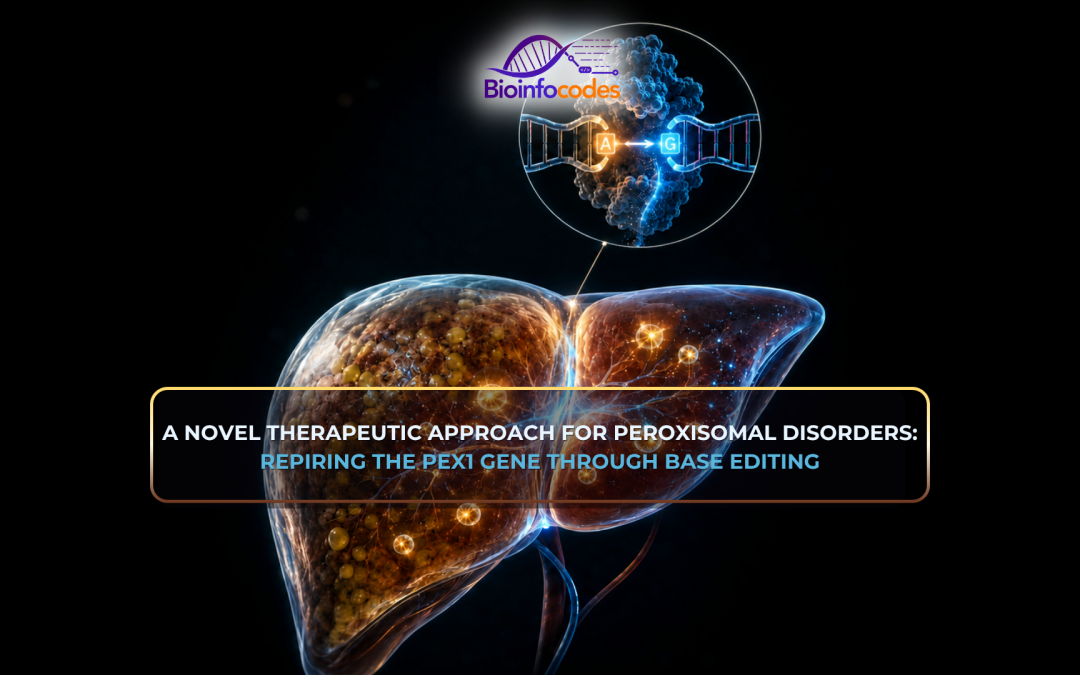
Zellweger spectrum disorder (ZSD) is a genetic disorder caused by mutations in PEX genes, which are responsible for the formation of peroxisomes, organelles that play critical roles in cellular metabolism and signal transduction. The PEX1-p.G843D mutation, observed in approximately 30% of ZSD cases, is known to cause chronic liver disease that can progress to cirrhosis, hepatocellular carcinoma (HCC), and neurological deterioration. Current treatment approaches are primarily supportive and do not target the genetic cause of the disease. Interventions such as liver transplantation are invasive and require long-term immunosuppressive therapy. This clinical landscape highlights the need for novel therapeutic strategies that directly correct the disease-causing mutations.
In this study, the researchers aimed to develop and evaluate an adenine base editing strategy to target the genetic basis of ZSD. The ability of the developed base editing approach to repair the mutated PEX1 gene and reverse disease-associated liver pathology and metabolic abnormalities was investigated under in vivo conditions using a homozygous mouse model.
Homozygous mice harboring the PEX1-p.G844D mutation, which exhibit liver pathology and metabolic dysfunction, were used in the study. A high-fidelity base editor, ABE8e-V106W, was delivered to the circulation of neonatal and 4-week-old mice via adeno-associated virus serotype 9 (AAV9) and lipid nanoparticles (LNPs). The efficacy and safety of the treatment were evaluated using high-throughput sequencing, RNA sequencing (RNA-seq), mass spectrometry-based fatty acid profiling, and off-target mutation analyses.
The adenine base editing strategy corrected the mutation in the pathogenic allele in up to 60% of hepatocytes. This genetic repair restored peroxisomal function and eliminated the hepatic accumulation of very-long-chain and branched-chain fatty acids, as well as toxic C27 bile acid intermediates. The liver transcriptomes and histopathological features of treated mice returned to normal in a dose-dependent manner. In addition, an increase in body weight was observed in the treated animals. Comprehensive analyses of both human and mouse genomes revealed minimal off-target DNA and RNA alterations. These findings suggest that in vivo base editing has the potential to improve the course of ZSD-associated liver pathology across different stages of life. Furthermore, the results provide a foundation for future research on the treatment of peroxisomal disorders.
Translated by: Özsu Deniz Balkaya
Editor: Elinsu Ak
Referans: Gao, X. D., Presa, M., Duby, J. E., Ryan, J., Piec, P. A., Hsu, A., Banskota, S., Jiang, A. Y., Chen, L., Newby, G. A., Di Pietro, E., Levy, J. M., Steele, B. H., Lecordier, S., Qin, F., Moser, A. B., Xie, J., Gao, G., Braverman, N. E., Zuberi, A. R., … Liu, D. R. (2025). In vivo base editing rescues liver pathophysiology and peroxisome dysfunction in a mouse model of Zellweger spectrum disorder. Nature Biomedical Engineering, 10.1038/s41551-026-01651-5. Advance online publication. https://doi.org/10.1038/s41551-026-01651-5
-Bioinfocodes Scientific News Service-
News articles prepared by our team members, reviewing and compiling scientific research
published in journals with and impact factor greater than 20 (click here for the list)