Understanding how individual cells interact to shape tissue function remains a central focus in multicellular biology and biotechnology. While recent advances in single-cell transcriptomics (the profiling of RNA expression in individual cells) and spatial profiling have illuminated molecular states and their spatial organization within tissues, these approaches cannot fully capture how cells directly influence one another in real time. Existing methods like single-cell RNA sequencing (scRNA-seq) isolate cells from their native physical contexts, masking partner-dependent responses, while spatial transcriptomics infers intercellular communication from proximity or correlated expression rather than direct receptor-ligand engagement. Defining the functional outcome of direct cell-cell interactions is therefore essential for moving from static cellular atlases to predictive, functional models of tissue dynamics.
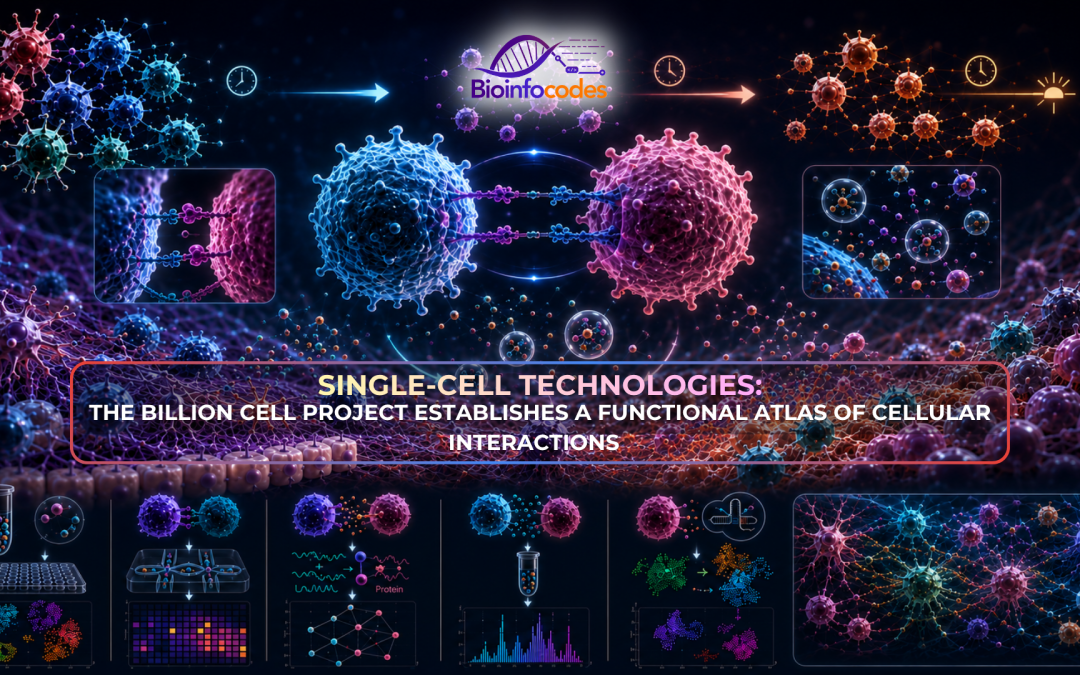
To address this knowledge gap, researchers have proposed a multi-institutional initiative to systematically map and engineer the human cell-cell interactome—a comprehensive functional atlas mapping communication across all major human cell types. The fundamental limitation in the field stems from the challenge of resolving complex, multi-cell interactions without confounding indirect niche effects or asynchronous timing. To overcome this bottleneck, the authors advocate for the cellular dyad (a defined physical interaction between two single cells) as a tractable and causal unit of intercellular communication. The primary objective of this effort is to launch the “Billion Cell-Cell Project,” an initiative aimed at capturing roughly one billion dyadic measurements to construct a foundational, causal layer connecting molecular engagement, transcriptional states, and downstream cellular functions across diverse conditions, perturbations, and genetic backgrounds.
The proposed experimental framework is structured into three progressive stages ordered by technology readiness. Stage 1 focuses on capturing interaction-induced transcriptomic programs by physically pairing single cells using high-throughput microscale compartmentalization platforms such as nanovials (microengineered hydrogel bowls used to pair and culture single cells), microwells, or droplets. Controlled co-encapsulation synchronizes interaction onset, allowing dual-labeled cellular dyads to be isolated and sequenced via droplet-based scRNA-seq alongside pseudomixed controls (computational or physical controls of unmixed single cells used to baseline background expression). Stage 2 incorporates pooled genetic perturbations—including CRISPR interference or activation, Cas9 knockouts, and synthetic receptor libraries such as synNotch (synthetic Notch receptors that decouple extracellular sensing from custom intracellular outputs)—into sender or receiver cells to map causal signaling logic. Stage 3 integrates upstream molecular binding events with downstream functional readouts by combining proximity labeling methods like Prox-seq (a method using antibody-oligonucleotide conjugates to measure physical proximity of surface proteins) with secretion-capture assays like SEC-seq (secretion-encoded single-cell sequencing) and functional imaging.
The project outlines how these interaction-resolved datasets can systematically illuminate and control cellular signaling pathways. By profiling heterotypic (interactions between different cell types) and homotypic (interactions between same cell type) dyads across prioritized cell types under varied conditions, the framework demonstrates how pairwise datasets isolate direct partner-induced transcriptional programs from indirect microenvironmental noise. Furthermore, the incorporation of perturbation libraries in dyadic cultures reveals causal signaling networks and identifies molecular bottlenecks in communication pathways. The framework also highlights how synthetic biology tools—such as engineered cytokines (like Synthekines or Novokines designed to alter receptor dimerization geometry), bispecific engagers, and targeted protein degraders such as LYTACs (lysosome-targeting chimeras)—can be deployed to selectively rewire, amplify, or degrade specific communication channels.
This multi-stage mapping effort provides a structured foundation for computational modeling and therapeutic engineering. Dyad-resolved datasets provide the necessary compositional training data to bridge independently trained single-cell models into predictive, multicellular foundation models capable of simulating tissue-level logic and predicting cellular responses to novel perturbations. In biomedical applications, such functional interactome maps offer a testbed for rational drug design, enabling the in silico development of logic-gated cell therapies, spatially restricted protein therapeutics, and targeted interventions aimed at reversing pathogenic communication loops in chronic conditions such as cancer and tissue fibrosis.
Author: Elinsu Ak
Editor: Nehir Necem Ünlü
Reference: Di Carlo D., Morsut L., McCain M. L., Wright H. J., Abedi M., Yamada-Hunter S. A., Zhang J. Z., Backus K., Chung E., Wang Y., Rando T. A., Cai L., Thomson M., Elowitz M. B., Lee J. K., Witte O. Mapping and engineering the human cell-cell interactome. Nature Biotechnology (2026). https://doi.org/10.1038/s41587-026-03177-2.
-Bioinfocodes Scientific News Service-
News articles prepared by our team members, reviewing and compiling scientific research
published in journals with and impact factor greater than 20 (click here for the list)