
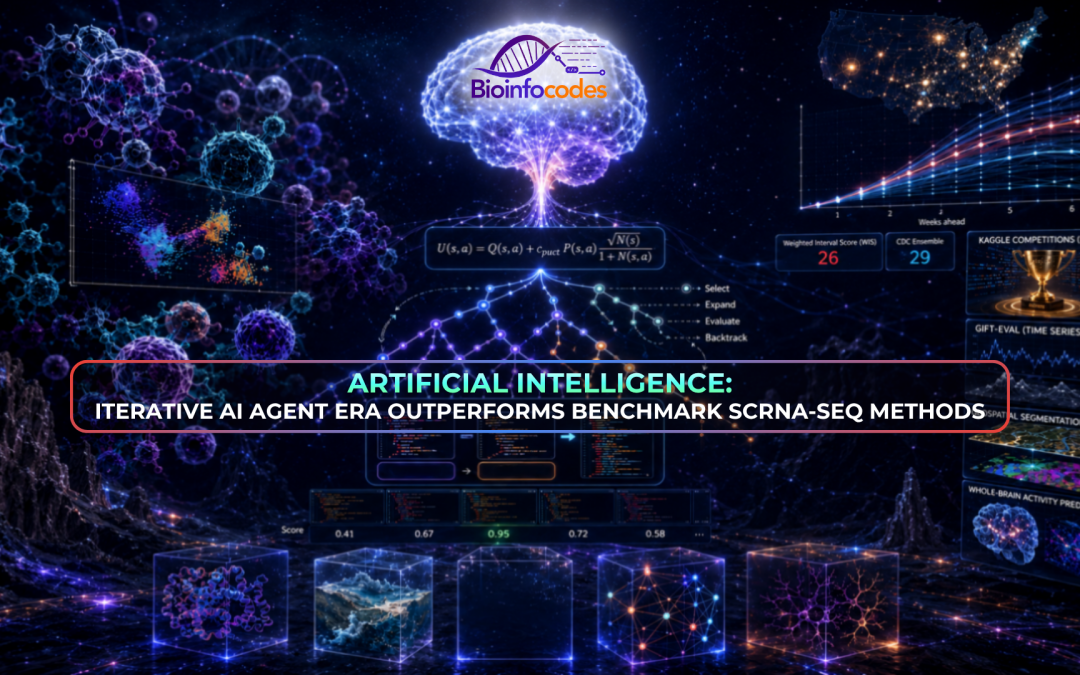
Computational methods have become essential for scientific research, supporting applications ranging from genomics to disease forecasting. However, developing high-performing scientific software often requires repeated experimentation and optimization. Although large language models (LLMs; artificial intelligence models capable of generating text and code) can produce code, they are typically used for one-shot generation, with limited opportunities for systematic improvement.
To address this limitation, researchers developed ERA (Empirical Research Assistance), an AI system that iteratively generates and refines scientific software. Rather than producing one final program, ERA evaluates multiple candidate solutions and improves them through tree search (an algorithm that systematically explores different solution pathways). The system can also incorporate research ideas derived from scientific literature and previously generated solutions to guide the optimization process.
The authors evaluated ERA across several computational research tasks, including single-cell RNA sequencing (scRNA-seq; a method for measuring gene expression in individual cells), COVID-19 hospitalization forecasting, geospatial semantic segmentation, neural activity prediction, and computational mathematics. In the OpenProblems benchmark for scRNA-seq batch integration, ERA outperformed the corresponding published implementation for eight of nine evaluated methods, with its best-performing implementation achieving a 14% improvement over the best published method. The study also reported that 40 ERA-generated methods exceeded existing approaches on the OpenProblems leaderboard, while 14 forecasting strategies outperformed the official CovidHub-ensemble in retrospective evaluations.
According to the authors, ERA demonstrates that iterative AI-guided software development can be applied across a range of machine-evaluable scientific tasks. The study presents a framework for integrating code generation, automated optimization, and research ideas within a single computational workflow.
Computational methods have become essential for modern scientific research, supporting applications ranging from genomics to disease forecasting. However, developing high-performing scientific software often requires repeated testing, optimization, and domain expertise. Although large language models (LLMs; artificial intelligence models capable of generating text and code) can produce code, they typically generate a single solution with limited opportunities for systematic improvement.
To address this limitation, researchers developed ERA (Empirical Research Assistance), an AI system that iteratively generates and refines scientific software. Rather than producing one final program, ERA evaluates multiple candidate solutions and improves them through tree search (an algorithm that systematically explores different solution pathways). The platform can also incorporate research ideas derived from scientific literature and previously generated solutions to guide the optimization process.
The authors evaluated ERA across several computational research tasks, including single-cell RNA sequencing (scRNA-seq; a method for measuring gene expression in individual cells), COVID-19 hospitalization forecasting, geospatial semantic segmentation, neural activity prediction, and computational mathematics. In the OpenProblems benchmark for scRNA-seq batch integration, ERA outperformed the corresponding published implementation for eight of nine evaluated methods, with its best-performing implementation achieving a 14% improvement over the highest-ranked published approach. The study also reported that 40 ERA-generated methods exceeded existing approaches on the OpenProblems leaderboard, while 14 forecasting strategies outperformed the CDC COVID-19 ensemble model in retrospective evaluations.
According to the authors, ERA demonstrates that iterative AI-guided software development can be applied across a range of machine-evaluable scientific tasks. The study presents a framework for integrating code generation, automated optimization, and research knowledge within a single computational workflow.
Author: Melissa Öner
Editor: Nehir Necem Ünlü
Reference: Aygün, E., Belyaeva, A., Comanici, G. et al. An AI system to help scientists write expert-level empirical software.Nature 654 (2026). DOI: 10.1038/s41586-026-10658-6.
-Bioinfocodes Scientific News Service-
News articles prepared by our team members, reviewing and compiling scientific research published in journals with and impact factor greater than 20 (click here for the list)