
Eslem EkemenT., Nida Dereli ÇalışkanE., Ebru KavaklıR.
Stem cells are a group of cells that have the properties of differentiation, proliferation, and continuous self-renewal and can enable the production, repair, and regeneration of many tissues1-3. At the same time, if stem cells’ normal renewal and differentiation reach abnormal levels, they can lead to malignancies2. The term “stem cell” was first used by Ernest McCulloch and James Till in the 1960s when they discovered self-renewing hematopoietic progenitor cells and named them stem cells4,5. This review examines stem cell types, the current use of stem cells in clinical applications, and future perspectives.
Stem Cell Types
Stem cells, which can be found in adult tissues and embryos, are classified into different groups according to their differentiation potential: totipotent, pluripotent, multipotent, oligopotent, and unipotent6. Totipotent stem cells are known to have the ability to form all cell types of the embryo7,8. They are the stem cell type with the highest differentiation potential and can form embryos and non-embryonic structures6. Pluripotent stem cells are a type of stem cell that has the capacity to differentiate into all cell types of the body and play an important role in regenerative medicine. They have the ability to differentiate into multiple lineages9,10. Multipotent stem cells are capable of differentiating into all cell types of closely related lineages. The self-renewal ability of this stem cell type is limited and not fully understood10,11. Oligopotent stem cells can differentiate into two or more lineages of a specific tissue12,13. Unipotent stem cells are capable of differentiating only into a single lineage, and they have low differentiation potential10.
Classification of Stem Cells
1. Embryonic Stem Cells (ESC): ESCs, which belong to the pluripotent stem cell type, are derived from the inner cell mass of blastocysts and can differentiate into ectoderm, mesoderm, and endoderm (Figure 1)14.
2. Induced Pluripotent Stem Cells (iPSC): iPSCs, like ESCs, belong to the pluripotent stem cell type, but they are artificially derived from adult somatic cells, unlike ESCs (Figure 1)14.
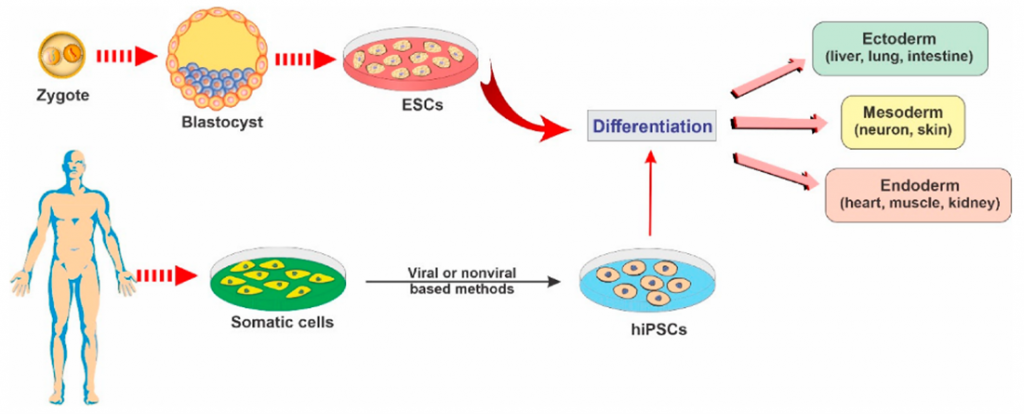
Figure 1. Differentiation potentials of ESC AND IPSCs14.
3. Mesenchymal Stem Cells (MSCs): MSCs, usually obtained from bone marrow and adipose tissue, are known for their self-renewal ability and differentiation potential15,16. MSCs play a significant role in tissue repair and hematopoiesis (formation of blood cells). Additionally, MSCs can interact with the microenvironment, which is important in the progression of diseases17.
4. Induced Totipotent Stem Cells: This stem cell class is formed by inducing totipotent stem cells, which can form the entire embryo8.
Clinical Applications Since the discovery of stem cells, stem cell technology has been used in many fields and continues to evolve today18. Stem cell technology, a new source of hope in diseases without a cure or treatment difficulties, holds great importance, especially in regenerative medicine. The utilization of stem cell technology in treatment is summarized in Figure 219.
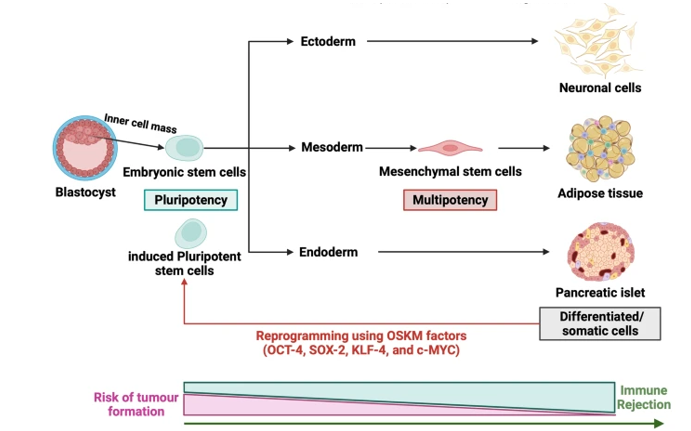
Figure 2. Stem cell-based therapy19. ESCs and iPSCs derived from the inner cell mass of the blastocyst primarily differentiate into three germ layers: ectoderm, mesoderm, and endoderm. Multipotent stem cells derived from the mesoderm give rise to mesenchymal stem cells. Using OSKM factors (Yamanaka factors, OCT-4, SOX-2, KLF-4, c-MYC), differentiated/somatic cells can be induced to form pluripotent stem cells. Somatic cells have a lower risk of tumor formation, but a higher risk of immune rejection compared to stem cells.
When it comes to stem cell technology for chronic liver disease, MSCs are in the clinical phase (Phase I and II trials), while ESCs and iPSCs are in the preclinical stage. MSCs are known as the most used cell source for cell therapy in liver diseases20. In a study by Xue and colleagues, stem cell therapy for liver failure increased albumin (ALB) protein levels, which plays a significant role in liver function, and improved liver functions while reducing liver damage21. In another study evaluating the safety of umbilical cord-derived MSCs (UC-MSC) transfusions in liver failure, positive results and improvement in liver functions were reported, but the underlying mechanism was uncertain22. In a recent meta-analysis study, it has been stated that MSC therapy has a positive effect on liver functions without significant side effects. MSC therapy has been highlighted as a potential method for the treatment of acute and chronic liver failure and cirrhosis, but further studies are needed for other liver diseases23.
When we look at the role of stem cells in cardiovascular diseases, despite advancements in surgical and medical treatments for ischemic heart disease (IHD), some patients with IHD may not be eligible for treatment. Treatment of IHD using iPSCs derived from the patient’s cells, aiming to eliminate the risk of immune rejection, is a promising therapeutic approach24. A recent exciting development is the generation of human-engineered heart tissues (hEHTs) that mimic the human heart, which holds promise for disease modeling of various heart conditions, heart regeneration, heart pumps, etc. Unlike cardiac organoids, hEHTs are designed to mimic the human heart and show great potential in the field of cardiovascular research25.
In addition to promising therapeutic approaches, the use of stem cells in cancer treatment is controversial. While some studies suggest that MSCs may promote tumor development, others indicate that they may suppress tumor growth. The dual pro-tumor and anti-tumor effects of MSCs hinder their use in oncology (Figure 3)26. Further studies are needed to better understand the connection between MSCs and cancer cells26.
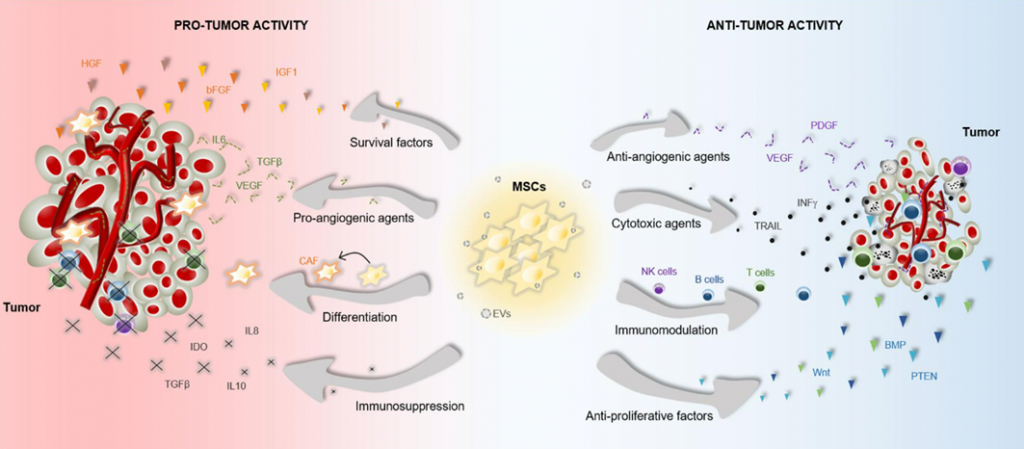
Figure 3. Pro-tumor and anti-tumor effects of MSCs26. MSCs can secrete agents with pro-tumor and anti-tumor effects that can impact angiogenesis, survival, and differentiation. These agents can be released to the tumor either through extracellular vesicles or directly.
One of the current methods searched for cancer treatment is targeted delivery systems using stem cell membranes camouflaged for a specific distribution. This treatment method targets tumor tissues using stem cell-based delivery systems. While this method shows promise, the use of inappropriate stem cells can also support tumor growth and lead to negative outcomes27. Due to the inadequacy of current treatments for neurological disorders, stem cell therapy holds great importance in neurodegenerative diseases. Clinical trials are being conducted for the treatment of Alzheimer’s Disease (AD) using human umbilical cord-derived MSCs28. Although studies using ESCs, fetal and adult neural stem cells (NSCs), MSCs, hematopoietic stem cells, and iPSCs are being conducted for AD treatment, they are limited due to differences in brain anatomy and microenvironment between animal models and AD patients29.
Currently, there is no effective treatment method for Parkinson’s disease (PD). Studies using fetal tissue in stem cell therapy have been limited due to ethical restrictions, which has resulted in inadequate research. In recent years, using specialized human PSC-derived dopamine neurons has emerged as a promising treatment approach for PD30. Stem cells have become a primary focus of interest in the treatment of diseases due to their ability to self-renew and differentiate. While certain types of stem cells can be used in the treatment of specific diseases, other types of stem cells are restricted ethically and cannot be used in treatments. Consequently, the effects and mechanisms of stem cells are among the current topics that require further research.
References
- Staniowski, T., Zawadzka-Knefel, A., & Skośkiewicz-Malinowska, K. (2021). Therapeutic potential of dental pulp stem cells according to different transplant types. Molecules, 26(24). https://doi.org/10.3390/molecules26247423
- Lin, Z., Tang, X., Wan, J., Zhang, X., Liu, C., & Liu, T. (2021). Functions and mechanisms of circular RNAs in regulating stem cell differentiation. RNA Biology, 18(12), 2136–2149. https://doi.org/10.1080/15476286.2021.1913551
- Laplane, L., & Solary, E. (2019). Philosophy of Biology: Towards a classification of stem cells. ELife, 8, 1–5. https://doi.org/10.7554/eLife.46563
- MCCULLOCH, E. A., & TILL, J. E. (1960). The radiation sensitivity of normal mouse bone marrow cells, determined by quantitative marrow transplantation into irradiated mice. Radiat Res, 113, 115–125. https://pubmed.ncbi.nlm.nih.gov/13858509/
- Becker A J, McCulloch E A, & Till J E. (1963). Cytological demonstration of the clonal nature of spleen colonies derived from transplanted mouse marrow cells. Nature, 197, 452–454. https://doi.org/10.1038/197452a0
- Zakrzewski, W., Dobrzyński, M., Szymonowicz, M., & Rybak, Z. (2019). Stem Cells: Past, Present and Future. IEEJ Transactions on Fundamentals and Materials, 10(68), 329–332. https://doi.org/10.1541/ieejfms.128.329
- Malik, V., & Wang, J. (2022). Pursuing totipotency: authentic totipotent stem cells in culture. Trends in Genetics, 38(7), 632–636. https://doi.org/10.1016/j.tig.2022.03.012
- Ghazimoradi, M. H., Khalafizadeh, A., & Babashah, S. (2022). A critical review on induced totipotent stem cells: Types and methods. Stem Cell Research, 63(June), 102857. https://doi.org/10.1016/j.scr.2022.102857
- Diamante, L., & Martello, G. (2022). Metabolic regulation in pluripotent stem cells. Current Opinion in Genetics and Development, 75, 101923. https://doi.org/10.1016/j.gde.2022.101923
- Rajabzadeh, N., Fathi, E., & Farahzadi, R. (2019). Stem cell-based regenerative medicine. Stem Cell Investigation, 6(July). https://doi.org/10.21037/sci.2019.06.04
- Sobhani, A., Khanlarkhani, N., Baazm, M., Mohammadzadeh, F., Najafi, A., Mehdinejadiani, S., & Aval, F. S. (2017). Multipotent stem cell and current application. Acta Medica Iranica, 55(1), 6–23. https://pubmed.ncbi.nlm.nih.gov/28188938/
- Poliwoda, S., Noor, N., Downs, E., Schaaf, A., Cantwell, A., Ganti, L., Kaye, A. D., Mosel, L. I., Carroll, C. B., Viswanath, O., & Urits, I. (2022). Stem cells: a comprehensive review of origins and emerging clinical roles in medical practice. Orthopedic Reviews, 14(3). https://doi.org/10.52965/001C.37498
- Kolios, G., & Moodley, Y. (2012). Introduction to stem cells and regenerative medicine. Respiration, 85(1), 3–10. https://doi.org/10.1159/000345615
- Sivandzade, F., & Cucullo, L. (2021). Regenerative stem cell therapy for neurodegenerative diseases: An overview. International Journal of Molecular Sciences, 22(4), 1–21. https://doi.org/10.3390/ijms22042153
- Zhang, Y., Dong, N., Hong, H., Qi, J., Zhang, S., & Wang, J. (2022). Mesenchymal Stem Cells: Therapeutic Mechanisms for Stroke. International Journal of Molecular Sciences, 23(5), 1–12. https://doi.org/10.3390/ijms23052550
- Han, Y., Yang, J., Fang, J., Zhou, Y., Candi, E., Wang, J., Hua, D., Shao, C., & Shi, Y. (2022). The secretion profile of mesenchymal stem cells and potential applications in treating human diseases. Signal Transduction and Targeted Therapy, 7(1). https://doi.org/10.1038/s41392-022-00932-0
- Liu, J., Gao, J., Liang, Z., Gao, C., Niu, Q., Wu, F., & Zhang, L. (2022). Mesenchymal stem cells and their microenvironment. Stem Cell Research and Therapy, 13(1), 1–10. https://doi.org/10.1186/s13287-022-02985-y
- Yu, H., Commander, C. W., & Stavas, J. M. (2021). Stem Cell-Based Therapies: What Interventional Radiologists Need to Know. Seminars in Interventional Radiology, 38(5), 523–534. https://doi.org/10.1055/s-0041-1736657
- Hoang, D. M., Pham, P. T., Bach, T. Q., Ngo, A. T. L., Nguyen, Q. T., Phan, T. T. K., Nguyen, G. H., Le, P. T. T., Hoang, V. T., Forsyth, N. R., Heke, M., & Nguyen, L. T. (2022). Stem cell-based therapy for human diseases. Signal Transduction and Targeted Therapy, 7(1). https://doi.org/10.1038/s41392-022-01134-4
- Li, T. T., Wang, Z. R., Yao, W. Q., Linghu, E. Q., Wang, F. S., & Shi, L. (2022). Stem Cell Therapies for Chronic Liver Diseases: Progress and Challenges. Stem Cells Translational Medicine, 11(9), 900–911. https://doi.org/10.1093/stcltm/szac053
- Xue, R., Meng, Q., Dong, J., Li, J., Yao, Q., Zhu, Y., & Yu, H. (2018). Clinical performance of stem cell therapy in patients with acute-on-chronic liver failure: A systematic review and meta-analysis. Journal of Translational Medicine, 16(1), 1–13. https://doi.org/10.1186/s12967-018-1464-0
- Shi, M., Zhang, Z., Xu, R., Lin, H., Fu, J., Zou, Z., Zhang, A., Shi, J., Chen, L., Lv, S., He, W., Geng, H., Jin, L., Liu, Z., & Wang, F.-S. (2012). Human Mesenchymal Stem Cell Transfusion Is Safe and Improves Liver Function in Acute-on-Chronic Liver Failure Patients. Stem Cells Translational Medicine, 1(10), 725–731. https://doi.org/10.5966/sctm.2012-0034
- Liu, Y., Dong, Y., Wu, X., Xu, X., & Niu, J. (2022). The assessment of mesenchymal stem cells therapy in acute on chronic liver failure and chronic liver disease: a systematic review and meta-analysis of randomized controlled clinical trials. Stem Cell Research and Therapy, 13(1), 1–16. https://doi.org/10.1186/s13287-022-02882-4
- Liu, C., Han, D., Liang, P., Li, Y., & Cao, F. (2021). The Current Dilemma and Breakthrough of Stem Cell Therapy in Ischemic Heart Disease. Frontiers in Cell and Developmental Biology, 9(April), 1–12. https://doi.org/10.3389/fcell.2021.636136
- Cho, J., Lee, H., Rah, W., Chang, H. J., & Yoon, Y. S. (2022). From engineered heart tissue to cardiac organoid. Theranostics, 12(6), 2758–2772. https://doi.org/10.7150/thno.67661
- Hmadcha, A., Martin-Montalvo, A., Gauthier, B. R., Soria, B., & Capilla-Gonzalez, V. (2020). Therapeutic Potential of Mesenchymal Stem Cells for Cancer Therapy. Frontiers in Bioengineering and Biotechnology, 8(February), 1–13. https://doi.org/10.3389/fbioe.2020.00043
- Zhang, W., & Huang, X. (2022). Stem cell membrane-camouflaged targeted delivery system in tumor. Materials Today Bio, 16(June), 100377. https://doi.org/10.1016/j.mtbio.2022.100377
- Rahman, M. M., Islam, M. R., Islam, M. T., Harun-Or-rashid, M., Islam, M., Abdullah, S., Uddin, M. B., Das, S., Rahaman, M. S., Ahmed, M., Alhumaydhi, F. A., Emran, T. Bin, Mohamed, A. A. R., Faruque, M. R. I., Khandaker, M. U., & Mostafa-Hedeab, G. (2022). Stem Cell Transplantation Therapy and Neurological Disorders: Current Status and Future Perspectives. Biology, 11(1), 1–42. https://doi.org/10.3390/biology11010147
- Karvelas, N., Bennett, S., Politis, G., Kouris, N. I., & Kole, C. (2022). Advances in stem cell therapy in Alzheimer’s disease: a comprehensive clinical trial review. Stem Cell Investigation, 9, 0–3. https://doi.org/10.21037/sci-2021-063
- Barker, R. A., Parmar, M., Studer, L., & Takahashi, J. (2017). Human Trials of Stem Cell-Derived Dopamine Neurons for Parkinson’s Disease: Dawn of a New Era. Cell Stem Cell, 21(5), 569–573. https://doi.org/10.1016/j.stem.2017.09.014