
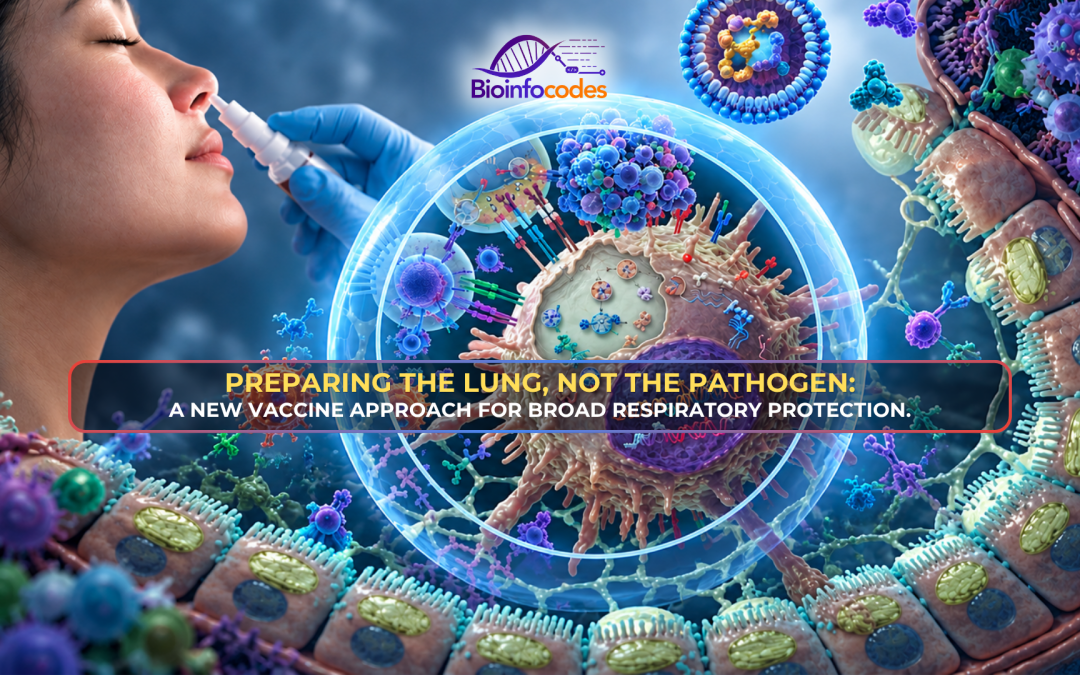
Respiratory infections continue to pose a major public health challenge because viruses, bacteria, and other respiratory pathogens exhibit considerable diversity and variability . Classical vaccinology typically incorporates antigens derived from the target pathogens, which limits their ability to provide broad protection against multiple respiratory diseases. Mucosal vaccination, which stimulates immune responses directly at the respiratory tract, has therefore emerged as an area of increasing interest. By inducing local secretory antibody responses and tissue-resident memory T cells responses at respiratory entry sites, this strategy may provide protection against infection and transmission In their commentary, Liu and Wang discuss a recent Science study by Zhang and colleagues that advances the concept of integrated organ immunity. The authors explain that conventional vaccine development has largely focused on pathogen-specific immune responses, whereas the reported study investigated whether coordinated interactions between innate and adaptive immunity could provide broader respiratory protection. Using an intranasal liposomal vaccine containing Toll-like receptor 4 (TLR4) and TLR7/8 agonists (GLA-3M-052-LS) together with ovalbumin (OVA), the original study examined immune responses against multiple respiratory challenges in mice.
The study evaluated immune protection following exposure to respiratory viruses, Staphylococcus aureus, Acinetobacter baumannii, and house dust mite-induced allergic asthma. According to the commentary, vaccination promoted the generation of long-lived tissue-resident memory T cells and induced epigenetic reprogramming (stable changes in gene regulation without altering DNA sequence) of alveolar macrophages (AMs; immune cells residing in the lungs). The authors further describe RANKL (receptor activator of nuclear factor-κB ligand) as a critical molecular mediator in this protective pathway.
Experimental findings summarized in the commentary indicate that vaccinated mice exhibited reduced viral loads, decreased weight loss, and reduced lung bacterial loads that persisted for at least three months following immunization . The study also reported reduced inflammatory cytokine production after respiratory challenge and protection against house dust mite-induced allergic asthma in mice. These findings are consistent with the integrated organ immunity framework described in the commentary, in which tissue-level coordination is proposed to contribute to broad protection against diverse respiratory threats.
Liu and Wang note that additional studies will be necessary to determine whether the same mechanisms operate in humans and to evaluate the durability and safety of this approach beyond animal models. According to the authors, the findings provide a framework for investigating vaccine strategies based on coordinated tissue-level immunity rather than pathogen-specific antigen matching alone.
The findings discussed by Liu and Wang also place emphasis on the role of tissue-level immune interactions in shaping respiratory responses after vaccination. In the reported model, protection was associated not only with adaptive immune components such as tissue-resident memory T cells but also with sustained changes in alveolar macrophage regulation, suggesting coordination between different immune compartments within the lung. The commentary notes that further work is needed to clarify the molecular mechanisms underlying this coordination, the persistence of the observed responses, and whether similar protective effects can be achieved in humans. Thus, the approach described in the commentary shifts attention from matching vaccines to individual pathogens toward investigating how the respiratory tissue itself can be conditioned to respond to multiple types of challenge.
Author : Melissa Öner
Editor: Nehir Necem Ünlü
Reference: Liu, Z., & Wang, S. (2026). New design for universal respiratory vaccines: A new paradigm on integrated immunity. hLife, 4, 463–466. https://doi.org/10.1016/j.hlife.2026.05.005
-Bioinfocodes Scientific News Service-
News articles prepared by our team members, reviewing and compiling scientific research
published in journals with and impact factor greater than 20 (click here for the list)