
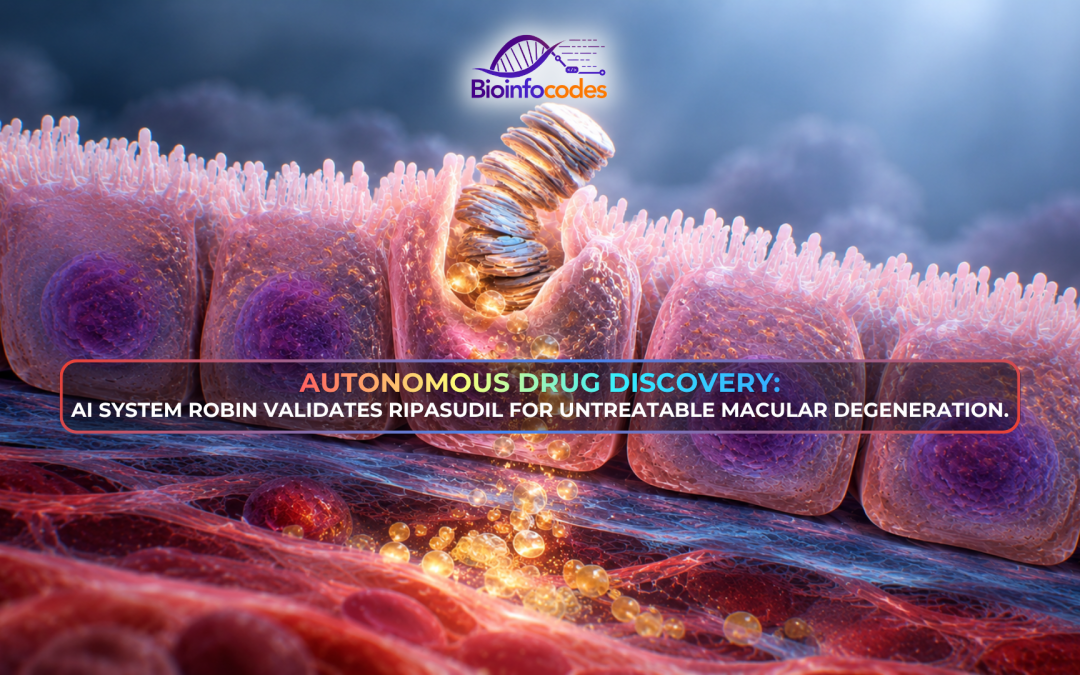
Scientific discovery relies on an iterative process of observation, hypothesis generation, experimentation, and data analysis, yet integrating these stages into a single automated workflow remains challenging. The study introduces Robin, a multi-agent system designed to integrate literature-based hypothesis generation with experimental data analysis. Robin coordinates specialized agents for literature search and data analysis, enabling hypotheses to be generated, experimentally tested, interpreted, and refined in an iterative lab-in-the-loop framework.
The researchers applied Robin as an initial proof of concept to dry age-related macular degeneration (dAMD). Robin reviewed 151 papers and proposed ten biologically relevant disease mechanisms and corresponding experimental strategies. After ranking these possibilities, the system selected increasing retinal pigment epithelium (RPE) cell phagocytosis as a therapeutic strategy. It subsequently reviewed approximately 400 papers concerning RPE phagocytosis and the therapeutic landscape of dAMD and proposed 30 existing drug candidates for experimental testing. The candidates were evaluated by the Falcon literature-search agent and ranked according to their scientific rationale, pharmacological profile, and supporting literature before human scientists selected candidates for laboratory testing.
For the initial screening, researchers used ARPE-19 cells and a flow-cytometry assay based on pHrodo beads to measure phagocytosis. Among the first five candidates tested were exendin-4, fingolimod, MFGE8, Y-27632, and the combination of AICAR and TUDCA. Y-27632 increased RPE phagocytosis and prompted Robin to propose follow-up RNA sequencing (RNA-seq) analysis. Finch, Robin’s data-analysis agent, identified changes involving actin filament organization, small GTPase signalling, and autophagy-related pathways; the authors noted that further work would be required to validate effects on autophagy. The differential expression analysis identified approximately threefold upregulation of ABCA1 in Y-27632-treated cells (adjusted P = 2.13 × 10⁻⁸³). In a subsequent screening round, Finch identified ripasudil, a ROCK (Rho-associated coiled-coil containing protein kinase) inhibitor, which increased RPE phagocytosis 1.89-fold relative to DMSO controls in ARPE-19 cells, while human analysis showed a 1.75-fold increase. Dose-response experiments indicated that ripasudil was more potent than Y-27632. The effect was subsequently validated in primary human RPE stem cell-derived cultures, where both compounds enhanced phagocytosis and ripasudil again showed greater potency. KL001, a circadian clock modulator, was also identified as a hit in these primary RPE cells. RNA-seq analysis further showed that ripasudil exposure increased ABCA1 expression in these cells.
Beyond the individual drug candidates, the study demonstrates a workflow in which AI-generated hypotheses, laboratory experiments, and autonomous data analysis continuously inform subsequent scientific questions. Robin analysed approximately 551 papers in 30 minutes, compared with an estimated 294 hours for a human performing an equivalent literature-synthesis task. The authors estimated that the total cognitive labour for a discovery cycle could be reduced from 359–424 human hours to less than 2 hours. However, the experimental workflow remained semi-autonomous, with human scientists conducting the laboratory experiments. The findings therefore provide a proof of concept for integrating multi-agent AI with experimental biology and demonstrate how iterative analysis of experimental results can be used to generate subsequent therapeutic hypotheses.
Author: Nehir Necem Ünlü
Editor: Nur Tanem Altundaş
Reference: Ghareeb, A. E., Chang, B., Mitchener, L., Yiu, A., Szostkiewicz, C. J., Shved, D., Gyimesi, G. J., Laurent, J. M., Wright, S. M., Razzak, M. T., White, A. D., Finnemann, S. C., Hinks, M. M., & Rodriques, S. G. (2026). A multi-agent system for automating scientific discovery. Nature, 655(8080), 497–505. https://doi.org/10.1038/s41586-026-10652-y
-Bioinfocodes Scientific News Service-
News articles prepared by our team members, reviewing and compiling scientific research
published in journals with and impact factor greater than 20 (click here for the list)