

Fatma Betül Tekiner A. Ebru Kavaklı E.
Introduction
Migraine is one of the most prevalent and incapacitating neurological disorders1 linked to triggers2. According to the results of the latest Global Burden of Disease survey, migraine continues to rank first among young women and is one of the leading causes of disability worldwide3. Migraine is defined by recurrent attacks of moderate to severe headaches as well as reversible neurological and systemic symptoms. The characteristic symptoms of migraines often involve sensitivity to light (photophobia), responsiveness to sound (phonophobia), and gastrointestinal problems such as nausea and vomiting4. Almost one billion people5, nearly 15% of the population, experience recurrent headaches worldwide because of migraine. Migraine has a substantial negative impact on socialization, education, and quality of life2.
The existence, characteristics, severity, length, frequency, and related aspects of migraine attacks vary greatly between individuals and can also vary significantly among patients throughout a lifetime6.
Based on The International Classification of Headache Disorders third edition (ICHD-3), diagnosing migraine requires thoroughly evaluating the patient’s history of illness and doing a comprehensive physical assessment. As a result, among other classifications, migraine can be divided into migraine with aura (MWA) and migraine without aura (MWoA)7. Aura, reversible temporary focal neurological symptoms originating from the cortex or brainstem, can occur in up to one-third of migrainers. Additionally, there are two types of migraine: chronic and episodic8.
Plenty of clinical research has examined the factors that cause migraines, either through patient self-report, questionnaires given by doctors, or patient diaries. The most frequent causes of migraine attacks have been identified by large-scale systematic reviews, with stress, auditory stimuli, exhaustion, fasting, and menstruation being the most constantly mentioned ones, respectively9. Migraines are underdiagnosed and undertreated by researchers. Furthermore, the treatment of migraines incorporates a combination of non-pharmacological and pharmacological approaches10. In this review, we will discuss the pathophysiology, triggers, and up-to-date pharmacological and non-pharmacological methods of migraine.
Migraine is characterized as a neurovascular illness with a headache that is common in those with a hereditary susceptibility and is brought on by a variety of influences11. There are two main types of migraine: episodic and chronic. Episodic migraine is defined as occurring less than 15 days per month, while chronic migraine occurs 15 or more days per month for at least three months, according to ICHD-312. Besides, episodic migraines can last up to 72 hours but often last less than 4 hours13. Due to a combination of genetic predisposition and environmental variables such as stressful life events, obesity, and depression, as well as recurrent headache pain, patients with episodic migraine may develop chronic pain. These factors increase the chance of developing a chronic migraine by lowering the threshold for migraine attacks14.
Migraines can also be classified based on the presence or absence of aura. Aura refers to a group of neurological symptoms that occur before or during a migraine attack, such as visual disturbances, numbness or tingling in the face or limbs, and difficulty speaking15. MWA is the most common form of the condition, accounting for about 75% of cases, and lasts 4 to 72 hours; it typically manifests as a unilateral, throbbing, moderate to severe headache that can be followed by nausea, light and sound sensitivity (photophobia, and phonophobia), and is exacerbated worse by physical effort16 (see Table 1) 17.
Table 1. Migraine with and without aura according to ICHD3 diagnostic criteria17.
| Migraine Without Aura | Migraine With Aura |
| A. At least 5 attacks fulfilling criteria B-D B. Headache attacks lasting for 4-72 hr* C. Headache has at least 2 of the following 4 characteristics: – unilateral location – pulsating quality – moderate or severe pain intensity – aggravation by or causing avoidance – routine physical activity D. During headache at least one of the following: – nausea and/or vomiting – photophobia and phonophobia | A. At least 2 attacks fulfilling criteria B and C B. One or more of the following fully reversible aura symptoms: – visual – sensory – speech and/or language – motor – brainstem – retinal C. At least 3 of the following 6 characteristics: – at least one aura symptom spreads gradually over ≥5 min – two or more aura symptoms occur in succession – each individual aura symptom lasts for 5-60 min – at least one aura symptom is unilateral – at least one aura symptom is positive – the aura is accompanied, or followed within 60 min, by headache |
| *2-72 hours in children and adolescents <18. ICDH3, International Classification of Headache Disorders, Third Edition. | |
Pathophysiology/Mechanism
A migraine attack can be classified into four phases: the premonitory, aura, headache, and postdrome phases18.
Premonitory Phase
There is ongoing debate regarding the duration of the premonitory phase in migraines, but the generally accepted definition describes it as a symptomatic phase that precedes the onset of aura or headache by up to 48 hours in a migraine attack19. It frequently shows symptoms including a desire for food, exhaustion, photophobia, mood changes, tension in the muscles, and yawning. Numerous of these signs exhibit daily fluctuations, pointing to the importance of homeostasis triggers and the preliminary involvement of the hypothalamus, limbic system, brain stem, and some cortical structures20.
Aura Phase
A migraine aura is described as a number of brief neurological abnormalities that last between 5 to 60 minutes each and are classified as temporary and reversible by ICHD-3. It is necessary for at least one of these abnormalities to be localized on one side of the body21.
It is still unclear how migraine auras are caused by a pathologic process. Cortical spreading depression (CSD), an electrophysiological condition, has been proposed as the mechanism causing migraine aura to date22. CSD mainly impacts neurons and glial cells and is triggered by changes in cerebral blood flow, an ionic imbalance, differences in neurotransmitter levels, and changes in the brain’s energy metabolism23. Studies on animals showed that CSD can stimulate meningeal trigeminovascular neurons, which in turn activate the trigeminal ganglia and centers in the brainstem. These areas then transmit nociceptive signals to the thalamus and the cortex, which eventually cause the experience of pain24.
Headache Phase
Trigeminovascular system (TVS) activation is a hypothesis that occurs during the headache phase25 and was first proposed by Moskowitz and colleagues26 in 1979. TVS underlined the role of the trigeminal nerve and its axonal projections that carry vasoactive neuropeptide in migraine27. The generation of neuropeptides at the level of the dura mater, such as pituitary adenylate cyclase activating polypeptide (PACAP) and the calcitonin gene-related peptide (CGRP) and is thought to be a mediator of some migraine pain characteristics28.
During the headache phase of migraines, individuals experience severe, throbbing pain on the head’s one side21. This pain is caused by the activation of the TVS, started by higher brain centers like the hypothalamus and thalamus. Nociceptive fibers release inflammatory mediators, such as CGRP, substance P, and vaso-inhibitory peptide (VIP), which trigger signals along the trigeminovascular pathway. After crossing the brainstem, thalamic, hypothalamus, and basal ganglia nuclei, rising fibers from the trigeminal cervical complex (TCC) transmit signals to several cortical regions, where they are expressed as pain8.
Postdrome Phase
The postdrome stage of a migraine episode can extend for hours to days and is defined by a residual headache, exhaustion, and diminished cognitive abilities29. According to a prospective daily electronic diary study, 81% of migraine sufferers experienced at least one non-headache symptom during the postdrome. The postdrome phase is not yet described in the ICHD-3, despite being frequent and incapacitating. It is necessary to establish the phase and include it in the headache categorization to proceed and standardize crucial studies30 (see Figure 1)29.
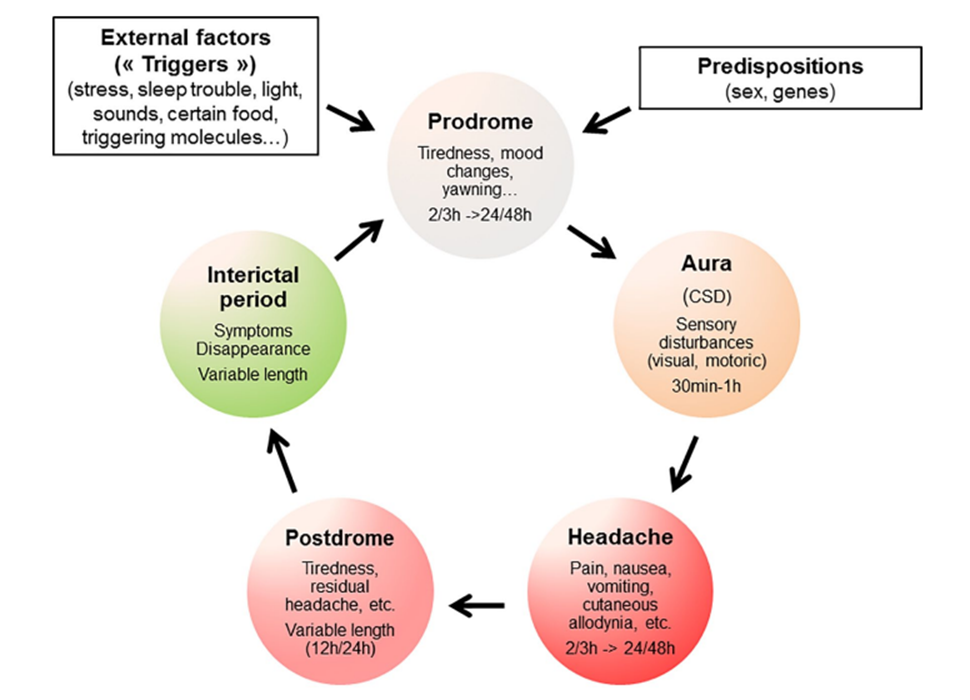
Figure 1. The migraine mechanism and its indications29. The cause of a migraine episode is a result of a confluence of internal and external variables. The different stages (red circles) change in length and are characterized by a range of symptoms that sometimes overlap. The termination of migraine-related symptoms can be correlated with the interictal period (green circle). This period might vary and will rely on a number of variables, including misuse of drugs.
Triggers
There are two categories of migraine triggers: internal (hormonal changes, stress, fasting or hunger, and disturbed sleep) and environmental (weather, odors, alcohol, and heat)31(see Figure 2)32. Researchers have discovered a link between food factors and migraines and have classified the condition as a metabolic-endocrine disorder. Nevertheless, the precise dietary elements that cause migraines are still up for discussion33. Hoffmann and Recober (2013)34 found that fatty foods, coffee, alcohol, chocolate, cheese, nuts, citrus fruits, processed meats, monosodium glutamate, and aspartame were the most often mentioned migraine triggers. A thorough investigation revealed that 27% and 44% of migraine sufferers were affected by alcohol and fasting as migraine triggers, respectively35.
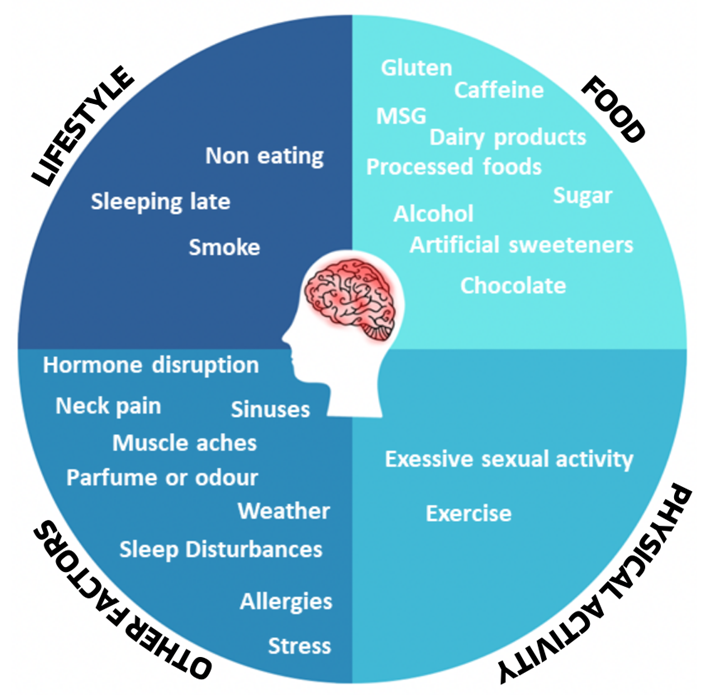
Figure 2. Factor causing migraines32.
Treatment Methods
Although the exact cause of migraine is still largely unknown, various effective therapeutic strategies have been proposed, which mainly involve the administration of triptans, ergots, acetaminophen, and nonsteroidal anti-inflammatory drugs (NSAIDs), either alone or in combination. However, there is still uncertainty regarding the real effectiveness of some prophylactic or preventive measures, such as drugs, lifestyle changes, and dietary habits, in many migraine patients36.
Pharmacological Approaches
The Clinical Trials Subcommittee of the International Headache Society recommends that clinical trials evaluating preventive treatments for migraines should use the number of migraine attacks or migraine days per 4-week intervals as a primary outcome measure. As a secondary measure, they suggest using the 50% responder rate, defined as the proportion of participants with at least a 50% improvement in migraine attack frequency or a 50% reduction in migraine days compared to baseline values. This approach provides an effective way to evaluate different drugs in clinical trials37.
Before the introduction of monoclonal antibodies that target the CGRP mechanism, onabotulinumtoxinA was the sole drug expressly permitted by the FDA for use in the prevention of CM. Additional medications approved by the FDA include topiramate, propranolol, divalproex sodium, and timolol38.
For almost three decades, triptans have served as the primary choice for the acute management of migraines18. Triptans function by selectively activating serotonin receptors, specifically the 5-HT1B and 5-HT1D receptors. This class of medications consists of eletriptan, frovatriptan, almotriptan, sumatriptan, naratriptan, rizatriptan, as well as zolmitriptan39. Additionally, it was shown that triptans reduced plasma levels of CGRP, a crucial neuropeptide involved in the underlying mechanisms of migraines. Furthermore, not every migraine patient experiences success with triptans. Only 12–40% of patients, based on the triptan used, report being pain-free two hours after taking the medication, which is the primary outcome in the majority of clinical trials for treatment40.
In recent times, the treatment of migraines has witnessed a remarkable transformation with the introduction of monoclonal antibodies targeting CGRP. Canada has approved four CGRP monoclonal antibodies, namely eptinezumab, fremanezumab, galcanezumab, and erenumab, which can be applied either subcutaneously or intravenously on a monthly or three-monthly basis. These medications have demonstrated efficacy in preventing both episodic and chronic migraines41
CGRP, a peptide consisting of 37 amino acids, is synthesized by neurons present in both the central nervous system (CNS) and the peripheral nervous system. It is identified as a potential regulator of various tasks in the nervous system, gastrointestinal tract, and cardiovascular system, CGRP has been associated with diverse physiological roles42.
Non-pharmacological Approaches
Non-pharmacological self-management interventions are a successful approach for managing chronic conditions, such as migraine and tension-type headaches. The underlying models emphasize the influence of behavioral factors in headache management, and these treatments aim to help patients manage pain and symptoms associated with their headaches more effectively by considering these factors43. As a result, non-pharmacological prevention approaches like exercise44, acupuncture45, and meditation46 are recommended to prevent overuse or as a primary headache treatment option 44.
The study by Varkey et al.47 used participants from the Nord-Trøndelag Health Survey to investigate the relationship between physical activity and headaches. The study had two parts: one using a prospective design (22,397 participants) and the other using a cross-sectional design (46,648 participants). In the prospective part of the study, physically active individuals reported fewer non-migraine headaches than physically inactive individuals. In the cross-sectional part, both migraine and non-migraine headaches were more common among those reporting low physical activity48.
In a study conducted by Boroujeni et al.49, they compared the effect of a combination of medication and a 12-week yoga program to medication alone on a group of 18 individuals. The yoga group attended three 75-minute sessions of yoga each week. The outcomes revealed that in comparison to the group who only took medication, the group that received medication and yoga experienced a statistically noteworthy decrease in headache frequency, severity, and effect.50.
Acupuncture
According to the guidelines from the National Institute for Health and Care Excellence (NICE), the sole non-pharmacological approach recommended for treating tension-type headaches is a series of acupuncture sessions43.
Acupuncture, which is considered one of the oldest healing techniques known to modern civilization: originated in China more than 3000 years ago. While it is commonly used in Asian countries, it is also gaining popularity worldwide. Acupuncture has a longstanding tradition of treating various pain conditions, including headaches51. The process involves the insertion of thin needles into specific acupoints along energy meridians. Although the mechanism behind acupuncture is not completely understood, studies suggest that it may stimulate different types of nerve fibers, resulting in the inhibition of pain transmission in the central nervous system. Acupuncture can also trigger the release of natural pain-relieving substances, including endorphins, serotonin, dopamine, and nitric oxide. Additionally, it may decrease serum matrix metalloproteinase-2, relieving migraine headaches52. A study found that acupuncture was quite effective in treating migraines. The study involved 160 patients with chronic tension-type headaches who ranged in age from 20 to 50 and were randomly assigned to either a dry needling or sham dry needling treatment group53.
The treatment was administered over 2 weeks in 3 sessions per week, targeting active trigger points in the head and neck muscles. As a result, the findings indicate that dry needling (DN) is a safe and effective treatment for reducing the frequency, severity, and duration of headaches53.
On the other hand, in a study conducted by Linde et al. in 201654, 22 trials involving 4,985 participants were analyzed. The patients in these trials were divided into groups receiving no treatment, sham acupuncture, medication, or true acupuncture. The findings revealed that acupuncture resulted in a significant reduction in migraine frequency by at least half in 41% of the participants, in contrast to only 17% in the no treatment group. 50% of patients had at least a halving of their migraine frequency after receiving acupuncture, compared to 41% after receiving sham acupuncture, and 57% after taking medication55.
Mindful‑Based Therapies
The widely recognized prevalent cause of headaches is stress, and controlling stress is essential to the psychological and behavioral treatment of headaches. Research conducted on adults has indicated that the practice of mindfulness has been successful in reducing stress levels, as well as decreasing both the frequency and intensity of headaches pain56.
Mindfulness-based stress reduction (MBSR), standardized treatment that combines mind and body techniques to promote momentary awareness and reduce sensory perception judgment, is linked to improvements in a range of chronic pain conditions. It notes that MBSR could be especially beneficial for individuals with migraines, as it can lessen the affective responses to stress, prevalent trigger for migraines46. A recent functional magnetic resonance imaging (fMRI) study examined how mindfulness can alter specific brain patterns associated with pain and migraines by affecting the activity of the insula, a key region of the brain involved in processing the sensory and emotional aspects of migraines57.
Physical activity
Exercise is considered a crucial treatment technique to reduce pain. Exercise-induced hypoalgesia, which is primarily associated with the activation of pain-inhibitory mechanisms, plays a significant role in treating chronic pain. It has already been suggested that including exercise in headache treatment will help to restore the CNS to normal function. Besides, the best therapeutic exercise routine may vary for each headache, though, due to the many pathogenic pathways that take place in each one58.
Conclusion
In summary, migraine is characterized by recurrent headaches that are often accompanied by nausea, light sensitivity, and visual disturbances. The exact pathophysiology of migraine is still not fully understood, but it is believed to involve a complex interplay between genetic, environmental, and biochemical factors. Acute and preventive drugs, dietary modifications, and complementary therapies like acupuncture, exercise, and mindfulness-based therapies are some treatment options for migraine. It is significant to remember that not every treatment is equally beneficial for every patient and that a customized approach to care may be required. More alternatives for acute and preventive migraine medication are now accessible as our understanding of the etiology of migraine has advanced. To sum up, additional research and development are needed and are predicted in the next years; perhaps this will aid in the dissemination of knowledge about a complex phenomenon that affects millions of people globally.
Drugs and treatment methods mentioned in the review article are based only on the information obtained from the articles. Please consult a specialist physician for diagnosis, treatment, and drug use.
References
- Puledda, F., & Shields, K. (2018). Non-pharmacological approaches for migraine. Neurotherapeutics, 15(2), 336–345. https://doi.org/10.1007/s13311-018-0623-6
- Andreou, A. P., & Edvinsson, L. (2019). Mechanisms of migraine as a chronic evolutive condition. Journal of Headache and Pain, 20(1). https://doi.org/10.1186/s10194-019-1066-0
- Aguilar-Shea, A. L., & Diaz-de-Teran, J. (2022). Migraine review for general practice. Atencion Primaria, 54(2). https://doi.org/10.1016/j.aprim.2021.102208
- Yeh, W. Z., Blizzard, L., & Taylor, B. V. (2018). What is the actual prevalence of migraine? Brain and Behavior, 8(6). https://doi.org/10.1002/brb3.950
- Hautakangas, H., Winsvold, B. S., Ruotsalainen, S. E., Bjornsdottir, G., Harder, A. V. E., Kogelman, L. J. A., Thomas, L. F., Noordam, R., Benner, C., Gormley, P., Artto, V., Banasik, K., Bjornsdottir, A., Boomsma, D. I., Brumpton, B. M., Burgdorf, K. S., Buring, J. E., Chalmer, M. A., de Boer, I., … Pirinen, M. (2022). Genome-wide analysis of 102,084 migraine cases identifies 123 risk loci and subtype-specific risk alleles. Nature Genetics, 54(2), 152–160. https://doi.org/10.1038/s41588-021-00990-0
- Ferrari, M. D., Goadsby, P. J., Burstein, R., Kurth, T., Ayata, C., Charles, A., Ashina, M., van den Maagdenberg, A. M. J. M., & Dodick, D. W. (2022). Migraine. In Nature Reviews Disease Primers (Vol. 8, Issue 1). Nature Research. https://doi.org/10.1038/s41572-021-00328-4
- Kincses, Z. T., Veréb, D., Faragó, P., Tóth, E., Kocsis, K., Kincses, B., Király, A., Bozsik, B., Párdutz, Á., Szok, D., Tajti, J., Vécsei, L., Tuka, B., & Szabó, N. (2019). Are Migraine With and Without Aura Really Different Entities? In Frontiers in Neurology (Vol. 10). Frontiers Media S.A. https://doi.org/10.3389/fneur.2019.00982
- Khan, J., Asoom, L. I. Al, Sunni, A. Al, Rafique, N., Latif, R., Saif, S. Al, Almandil, N. B., Almohazey, D., AbdulAzeez, S., & Borgio, J. F. (2021). Genetics, pathophysiology, diagnosis, treatment, management, and prevention of migraine. In Biomedicine and Pharmacotherapy (Vol. 139). Elsevier Masson s.r.l. https://doi.org/10.1016/j.biopha.2021.111557
- Marmura, M. J. (2018). Triggers, Protectors, and Predictors in Episodic Migraine. In Current Pain and Headache Reports (Vol. 22, Issue 12). Current Medicine Group LLC 1. https://doi.org/10.1007/s11916-018-0734-0
- R, P., S. C, N., S, H., & K, R. (2020). Migraine Disability, Quality of Life, and Its Predictors. Annals of Neurosciences, 27(1), 18–23. https://doi.org/10.1177/0972753120929563
- Günes¸, G., Albayrak, G., Saçmacı, H., Albayrak, L., Bozkurt, G., & Karaaslan, O. (2023). A cross-sectional study on the personality traits of episodic and chronic migraine patients. Clinical Neurology and Neurosurgery, 227, 107641. https://doi.org/10.1016/j.clineuro.2023.107641
- Burshtein, R., Burshtein, A., Burshtein, J., & Rosen, N. (2015). Are Episodic and Chronic Migraine One Disease or Two? https://doi.org/10.1007/s11916-015-0529-5
- Youssef, P. E., & Mack, K. J. (2020). Episodic and chronic migraine in children. Developmental Medicine and Child Neurology, 62(1), 34–41. https://doi.org/10.1111/DMCN.14338
- Gazerani, P. (2018). Current Evidence on the Role of Epigenetic Mechanisms in Migraine: The Way Forward to Precision Medicine. OBM Genetics, 2(4), 1–1. https://doi.org/10.21926/obm.genet.1804040
- Hansen, J. M., Goadsby, P. J., & Charles, A. C. (2016). Variability of clinical features in attacks of migraine with aura. https://doi.org/10.1177/0333102415584601
- Ruschel, M. A. P., & Jesus, O. De. (2023). Migraine Headache. Pain Medicine: An Essential Review, 521–524. https://doi.org/10.1007/978-3-319-43133-8_138
- Chan, C., Wei, D. Y., & Goadsby, P. J. (2019). Biochemical modulation and pathophysiology of migraine. Journal of Neuro-Ophthalmology, 39(4), 470–479. https://doi.org/10.1097/WNO.0000000000000875
- Haanes, K. A., & Edvinsson, L. (2019). Pathophysiological Mechanisms in Migraine and the Identification of New Therapeutic Targets. CNS Drugs, 33(6), 525–537. https://doi.org/10.1007/s40263-019-00630-6
- Gollion, C., De Icco, R., Dodick, D. W., & Ashina, H. (2022). The premonitory phase of migraine is due to hypothalamic dysfunction: revisiting the evidence. In Journal of Headache and Pain (Vol. 23, Issue 1). BioMed Central Ltd. https://doi.org/10.1186/s10194-022-01518-5
- G.R, T., & Z, K. (2020). Current concept of the pathophysiology of migraine and new targets for its therapy. https://doi.org/10.14412/2074-2711-2020-4-143-152
- Goadsby, P. J., Holland, P. R., Martins-Oliveira, M., Hoffmann, J., Schankin, C., & Akerman, S. (2017). Pathophysiology of Migraine: A Disorder of Sensory Processing. Physiol Rev, 97, 553–622. https://doi.org/10.1152/physrev.00034.2015.-Plaguing
- Close, L. N., Eftekhari, S., Wang, M., Charles, A. C., & Russo, A. F. (2019). Cortical spreading depression as a site of origin for migraine: Role of CGRP. In Cephalalgia (Vol. 39, Issue 3, pp. 428–434). SAGE Publications Ltd. https://doi.org/10.1177/0333102418774299
- Mathew, A. A., & Panonnummal, R. (2022). Cortical spreading depression: culprits and mechanisms. Experimental Brain Research, 240(3), 733–749. https://doi.org/10.1007/s00221-022-06307-9
- Eising, E., Shyti, R., ’t Hoen, P. A. C., Vijfhuizen, L. S., Sjoerd, &, Huisman, M. H., Broos, L. A. M., Mahfouz, A., Reinders, M. J. T., Ferrari, M. D., Tolner, E. A., Boukje De Vries, &, & Van Den Maagdenberg, A. M. J. M. (2016). Cortical Spreading Depression Causes Unique Dysregulation of Inflammatory Pathways in a Transgenic Mouse Model of Migraine. https://doi.org/10.1007/s12035-015-9681-5
- Mamindla, P., Mogilicherla, S., Enumula, D., Prasad, O. P., & Anchuri, S. S. (2019). A Review on Migraine. In Acta Scientific Pharmaceutical Sciences (Vol. 3). ISSN: 2581-5423
- Moskowitz, M. A. (1984). The neurobiology of vascular head pain. Annals of Neurology, 16(2), 157–168. https://doi.org/10.1002/ANA.410160202
- Ashina, M., Hansen, J. M., Do, T. P., Melo-Carrillo, A., Burstein, R., & Moskowitz, M. A. (2019). Migraine and the trigeminovascular system-40 years and counting. https://doi.org/10.1016/S1474-4422(19)30185-1
- Puledda, F., Silva, E. M., Suwanlaong, K., & Goadsby, P. J. (2023). Migraine: from pathophysiology to treatment. In Journal of Neurology. Springer Science and Business Media Deutschland GmbH. https://doi.org/10.1007/s00415-023-11706-1
- Verkest, C., Häfner, S., Ávalos Prado, P., Baron, A., & Sandoz, G. (2021). Migraine and Two-Pore-Domain Potassium Channels. In Neuroscientist (Vol. 27, Issue 3, pp. 268–284). SAGE Publications Inc. https://doi.org/10.1177/1073858420940949
- Bose, P., Karsan, N., & Goadsby, P. J. (2018). The Migraine Postdrome. CONTINUUM: Lifelong Learning in Neurology, 24(4), 1023–1031. https://doi.org/10.1212/CON.0000000000000626
- Zobdeh, F., ben Kraiem, A., Attwood, M. M., Chubarev, V. N., Tarasov, V. V., Schiöth, H. B., & Mwinyi, J. (2021). Pharmacological treatment of migraine: Drug classes, mechanisms of action, clinical trials and new treatments. In British Journal of Pharmacology (Vol. 178, Issue 23, pp. 4588–4607). John Wiley and Sons Inc. https://doi.org/10.1111/bph.15657
- Fila, M., Chojnacki, C., Chojnacki, J., & Blasiak, J. (2019). Is an “Epigenetic Diet” for Migraines Justified? The Case of Folate and DNA Methylation. Nutrients, 11(11), 2763. https://doi.org/10.3390/nu11112763
- Gazerani, P. (2020). Migraine and diet. In Nutrients (Vol. 12, Issue 6, pp. 1–11). MDPI AG. https://doi.org/10.3390/nu12061658
- Hoffmann, J., & Recober, A. (2013). Migraine and triggers: Post hoc ergo propter hoc? In Current Pain and Headache Reports (Vol. 17, Issue 10). Current Medicine Group LLC 1. https://doi.org/10.1007/s11916-013-0370-7
- Hindiyeh, N. A., Zhang, N., Farrar, M., Banerjee, P., Lombard, L., & Aurora, S. K. (2020). The Role of Diet and Nutrition in Migraine Triggers and Treatment: A Systematic Literature Review. In Headache (Vol. 60, Issue 7, pp. 1300–1316). Blackwell Publishing Inc. https://doi.org/10.1111/head.13836
- Lippi, G., Mattiuzzi, C., & Sanchis-Gomar, F. (2018). Physical exercise and migraine: for or against? Annals of Translational Medicine, 6(10), 181–181. https://doi.org/10.21037/atm.2018.04.15
- Loder, E., & Rizzoli, P. (2018). Pharmacologic Prevention of Migraine: A Narrative Review of the State of the Art in 2018. In Headache (Vol. 58, pp. 218–229). Blackwell Publishing Inc. https://doi.org/10.1111/head.13375
- Patel, N., Barnhart, R., Konkol, P., Varda, J., Nelson, R., & Smith, T. (2021). Treatment of migraine: a review of disease burden and an update on the therapeutic landscape for pharmacists. In Drugs and Therapy Perspectives (Vol. 37, Issue 2, pp. 75–86). Adis. https://doi.org/10.1007/s40267-020-00801-2
- Lipton, R. B., Marcus, S. C., Shewale, A. R., Dodick, D. W., Viswanathan, H. N., & Doshi, J. A. (2020). Acute treatment patterns in patients with migraine newly initiating a triptan. Cephalalgia, 40(5), 437–447. https://doi.org/10.1177/0333102420905307
- de Vries, T., Villalón, C. M., & MaassenVanDenBrink, A. (2020). Pharmacological treatment of migraine: CGRP and 5-HT beyond the triptans. In Pharmacology and Therapeutics (Vol. 211). Elsevier Inc. https://doi.org/10.1016/j.pharmthera.2020.107528
- MD, V. T., MD, W. J. B., & MBBS, T. L. H. C. (2023). Pharmacologic prevention of migraine. 195(5). https://doi.org/10.1503/cmaj.221607
- Charles, A., & Pozo-Rosich, P. (2019). Targeting calcitonin gene-related peptide: a new era in migraine therapy. In The Lancet (Vol. 394, Issue 10210, pp. 1765–1774). Lancet Publishing Group. https://doi.org/10.1016/S0140-6736(19)32504-8
- Probyn, K., Bowers, H., Mistry, D., Caldwell, F., Underwood, M., Patel, S., Sandhu, H. K., Matharu, M., & Pincus, T. (2017). Non-pharmacological self-management for people living with migraine or tension-type headache: A systematic review including analysis of intervention components. In BMJ Open (Vol. 7, Issue 8). BMJ Publishing Group. https://doi.org/10.1136/bmjopen-2017-016670
- Varangot-Reille, C., Suso-Mart, L., Romero-Palau, M., Su Arez-Pastor, P., & Cuenca-Mart Inez, F. (2022). Effects of Different Therapeutic Exercise Modalities on Migraine or Tension-Type Headache: A Systematic Review and Meta-Analysis with a Replicability Analysis. The Journal of Pain, 23(7), 1099–1122. https://doi.org/10.1016/j.jpain.2021.12.003
- Natbony, L. R., & Zhang, N. (2020). Acupuncture for Migraine: a Review of the Data and Clinical Insights. In Current Pain and Headache Reports (Vol. 24, Issue 7). Springer. https://doi.org/10.1007/s11916-020-00864-w
- Wells, R. E., O’Connell, N., Pierce, C. R., Estave, P., Penzien, D. B., Loder, E., Zeidan, F., & Houle, T. T. (2021). Effectiveness of Mindfulness Meditation vs Headache Education for Adults with Migraine: A Randomized Clinical Trial. JAMA Internal Medicine, 181(3), 317–328. https://doi.org/10.1001/jamainternmed.2020.7090
- Varkey, E., Hagen, K., Zwart, J.-A., Linde, & M., & Varkey, E. (2008). Physical activity and headache: results from the Nord-Trøndelag Health Study (HUNT). https://doi.org/10.1111/j.1468-2982.2008.01678.x
- Amin, F. M., Aristeidou, S., Baraldi, C., Czapinska-Ciepiela, E. K., Ariadni, D. D., Di Lenola, D., Fenech, C., Kampouris, K., Karagiorgis, G., Braschinsky, M., & Linde, M. (2018). The association between migraine and physical exercise. In The journal of headache and pain (Vol. 19, Issue 1, p. 83). https://doi.org/10.1186/s10194-018-0902-y
- Boroujeni, M. Z., Marandi, S. M., Esfarjani, F., Sattar, M., Shaygannejad, V., & Javanmard, S. H. (2015). Yoga intervention on blood NO in female migraineurs. https://doi.org/10.4103/2277-9175.172995
- Wang, C. D. H. (s-J., & Editor, S. (2021). Exercise in Treatment of Migraine Including Chronic Migraine. https://doi.org/10.1007/s11916-020-00929-w/Published
- Da Silva, A. N. (2015). Acupuncture for migraine prevention. Headache, 55(3), 470–473. https://doi.org/10.1111/HEAD.12525
- Farahmand, S., Shafazand, S., Alinia, E., Bagheri-Hariri, S., & Baratloo, A. (2018). Pain Management Using Acupuncture Method in Migraine Headache Patients; A Single Blinded Randomized Clinical Trial. Anesth Pain Med, 8(6), 81688. https://doi.org/10.5812/aapm.81688
- Gildir, S., Tüzün, E. H., Eroglu, G., & Eker, L. (2019). A randomized trial of trigger point dry needling versus sham needling for chronic tension-type headache. Medicine (United States), 98(8). https://doi.org/10.1097/MD.0000000000014520
- Linde, K., Allais, G., Brinkhaus, B., Fei, Y., Mehring, M., Vertosick, E. A., Vickers, A., & White, A. R. (2016). Acupuncture for the prevention of episodic migraine. Cochrane Database of Systematic Reviews, 2016(6). https://doi.org/10.1002/14651858.CD001218.PUB3
- Urits Megha Patel Mary Elizabeth Putz Nikolas Monteferrante Diep Nguyen Daniel An Elyse M Cornett Jamal Hasoon Alan D Kaye Omar Viswanath, I. R., Urits, I., Hasoon, Á. J., Patel Á E Putz Á D Nguyen Á O Viswanath, M. M., Monteferrante Á O Viswanath, N. R., An, D., & Cornett Á A D Kaye Á O Viswanath, E. M. (2020). Acupuncture and Its Role in the Treatment of Migraine Headaches. https://doi.org/10.6084/m9.figshare.12981695
- Rastogi, R. G., Arnold, T. L., Borrero-Mejias, C., Hastriter, E. V., Hickman, C., Karnik, K. T., Lewis, K. S., & Little, R. D. (2021). Non-pharmacologic and Mindful-Based Approaches for Pediatric Headache Disorders: a Review. In Current Pain and Headache Reports (Vol. 25, Issue 12). Springer. https://doi.org/10.1007/s11916-021-00993-w
- Grazzi, L., Grignani, E., Raggi, A., Rizzoli, P., & Guastafierro, E. (2021). Effect of a mindfulness-based intervention for chronic migraine and high frequency episodic migraine in adolescents: A pilot single-arm open-label study. International Journal of Environmental Research and Public Health, 18(22). https://doi.org/10.3390/ijerph182211739
- Fernández-De-Las-Peñas, C., Florencio, L. L., Plaza-manzano, G., & Arias-buría, J. L. (2020). Clinical reasoning behind non-pharmacological interventions for the management of headaches: A narrative literature review. In International Journal of Environmental Research and Public Health (Vol. 17, Issue 11, pp. 1–16). MDPI AG. https://doi.org/10.3390/ijerph17114126