Global organizations in healthcare and life sciences are leveraging NVIDIA technologies to accelerate drug discovery and enhance precision in patient care. Life sciences researchers aim to shorten the loop between computational design and laboratory testing as they screen vast biological design spaces to develop new drugs. Meanwhile, cancer care teams strive to transform complex imaging and treatment data into precise, patient-specific treatment plans. NVIDIA’s open models, accelerated computing, and physical intelligence technologies aim to help evaluate more possibilities faster, ranging from protein design to adaptive radiotherapy planning.
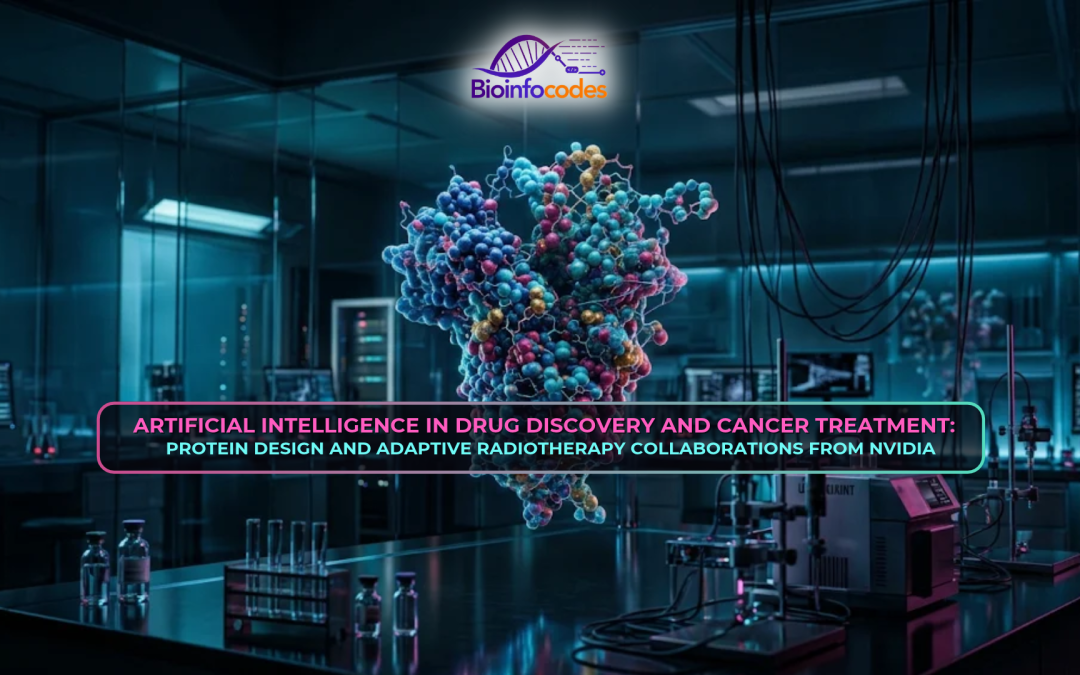
Announced by NVIDIA and the UW Medicine Institute for Protein Design at the University of Washington School of Medicine, RFD4-Proteina is a new NVIDIA BioNeMo open model that combines programmable protein design with search capabilities. Designing new forms of proteins that perform fundamental functions in living organisms can provide opportunities for developing new drugs, diagnostic methods, and industrial applications. The model generates targeted protein designs, enabling scientists and AI agents to search and refine designs using molecular inputs, constraints, and scoring objectives. Potential applications include designing proteins that can block disease processes and proteins capable of detecting disease markers in diagnostic tests.
In tests reported in the research preprint, RFD4-Proteina demonstrated higher computational design success rates and design generation capacity compared to baseline methods evaluated across four benchmark groups: protein binding, small molecule binding, enzyme scaffolding , and DNA binding. The model helps researchers explore and prioritize candidates for laboratory testing, where experiments establish how a design performs under tested conditions. Determining how the designs perform under tested conditions, however, requires laboratory experiments. David Baker, the 2024 Nobel Laureate in Chemistry and director of the Institute for Protein Design at the University of Washington, said that RFD4-Proteina expands the possibilities for designing new proteins, including proteins that could advance drug discovery and enzymes that break down pesticides. He also noted that making the model openly available would allow researchers worldwide to build on these capabilities and pursue previously inaccessible solutions. RFD4-Proteina is available today through partners including Amazon Bio Discovery, Anthropic Claude Science, Benchling, Databricks, Google Cloud, Hugging Face, Nebius, OpenAI, and Tamarind Bio.
Siemens Healthineers and NVIDIA are collaborating to advance next-generation adaptive radiotherapy by combining agentic and robotic intelligence with accelerated computing and simulation. It is projected that by 2050, nearly 35 million people worldwide will be diagnosed with cancer each year. In the face of this growing demand, delivering personalized treatment while considering the limited expert capacity of healthcare teams becomes increasingly critical. The goal in this process is to assist in precisely delivering the prescribed radiation dose to tumors while preserving surrounding healthy tissue.
Within the scope of the collaboration, the use of NVIDIA Nemotron open foundation models is being explored to power agentic co-planning, with the aim of helping oncologists evaluate and refine personalized treatment strategies. Combining these models with NVIDIA CUDA-accelerated dose calculations holds the potential to speed up patient-specific simulations. Meanwhile, the NVIDIA Holoscan platform aims to support adaptive therapy by streaming live sensor data into AI and simulation. Arthur Kaindl, head of the Varian cancer care business within Siemens Healthineers, highlighted the company’s advancements in precision and adaptability, referencing the recently launched Accela system. The collaboration with NVIDIA explores how AI and real-time computing can help clinicians make decisions with faster, more comprehensive information, tailor treatment to the patient, and deliver personalized care to more patients.
In the life sciences sector, global scientific research and development spending has reached $3.8 trillion, with annual pharmaceutical industry budgets approaching $300 billion. Scientific AI agents and autonomous laboratories can help turn these resources into new evidence, scientific findings, and potential therapies by unifying design, experimentation, and learning processes in a continuous loop. Research and laboratory technology companies are building systems that connect drug design, scientific data, and laboratory workflows using NVIDIA BioNeMo—an open platform developed for biology and drug discovery—alongside Nemotron and other NVIDIA technologies.
In this context, Benchling connects AI agents with experimental data, research context, and connected scientific workflows. Biolevate integrates biological data, specialized scientific tools, and agentic reasoning across drug discovery and development processes. Boltz develops specialized models and tools that scientific agents can use to predict molecular structures, as well as design and evaluate candidates. The company also offers a preview of a scientific agent aimed at planning workflows, applying appropriate models, and interpreting results to guide the next experiment. Automata develops systems to connect scientific agents with automated lab infrastructure, enabling experiments to be initiated and results to be recorded in a structured manner alongside their context.
Genedata’s AI-powered co-scientist system will coordinate protein design and testing workflows at Danaher’s autonomous lab protein design site. RFD4-Proteina will also be incorporated into this workflow, aiming to enable scientists to use experimental results to guide subsequent design rounds. Hologen is combining its large medicine models with NVIDIA Nemotron to build AI clinical scientists to derive patient outcome insights from imaging and clinical data, using this information to support the design of clinical trials. Therna Biosciences leverages the reasoning capabilities of large language models to link experimental evidence with RNA-based therapeutic design, supporting the translation of biological findings into potential treatment candidates.
European health systems are leveraging new technologies to improve access to specialized care and reduce the administrative burden on care teams. Avelios, Corti, Dedalus, Dawn Health, and Sword are building on NVIDIA Nemotron to support applications ranging from AI scribes and AI-assisted clinical care to personalized patient support services. PolyAI aims to accelerate healthcare access through multilingual conversational systems developed with medical software provider Corilus using the NVIDIA Agent Toolkit. Covering more than 70,000 healthcare professionals across Belgium and France, the Corilus network highlights the reach of this collaboration. Apian and VitVio are using NVIDIA Cosmos world models and NVIDIA Omniverse libraries to build digital twins that monitor and improve hospital operations.
Some of the products and features introduced in NVIDIA’s announcement are in various stages of development. The company notes that statements regarding future performance and benefits do not constitute guarantees, and timelines for product development, release, and availability are subject to change. NVIDIA states that some of the products and features described in the announcement remain at various stages of development, that future-oriented statements are not guarantees of future performance, and that development, release, and availability timelines may change.
Translated by: Elinsu Ak
Editor: Hazel Birgül
Reference: NVIDIA Newsroom. Healthcare and Life Sciences Leaders Build on NVIDIA to Advance Drug Discovery and Expand Patient Care. 21 October 2026.https://nvidianews.nvidia.com/news/healthcare-and-life-sciences-leaders-build-on-nvidia-to-advance-drug-discovery-and-expand-patient-care