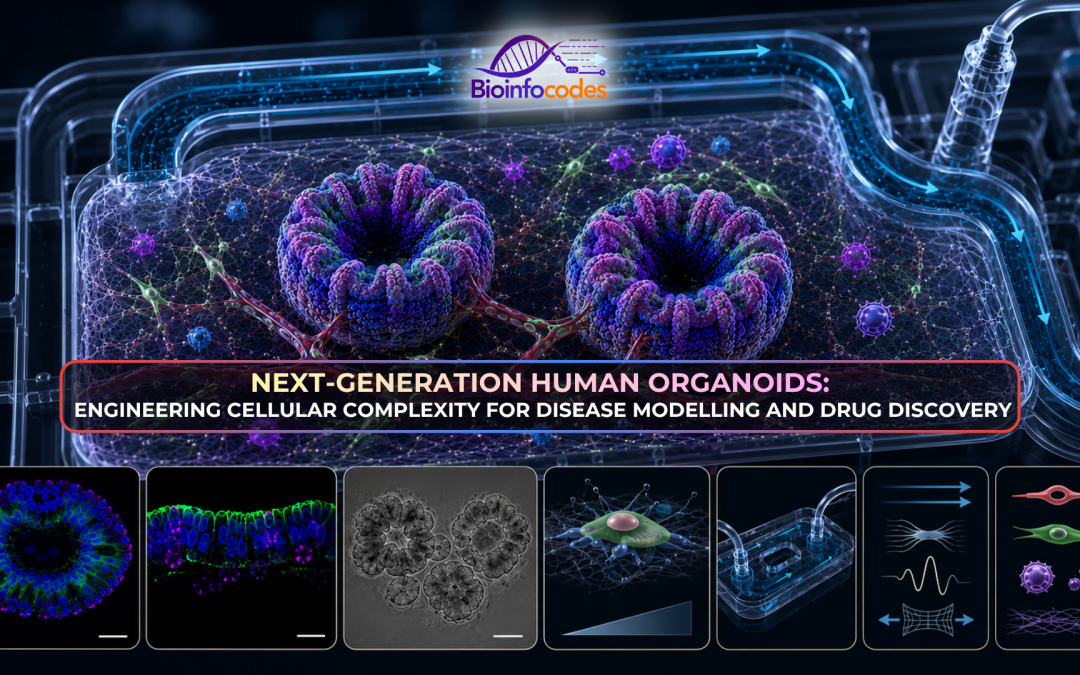
Human organoid technology has emerged as a powerful platform for studying human biology and disease in vitro. Organoids are self-organizing three-dimensional (3D) cellular structures derived from pluripotent stem cells (PSCs) or tissue-resident stem cells that recapitulate key characteristics of native tissues. Compared with conventional cell lines, organoids preserve greater cellular heterogeneity and can be established from both healthy and diseased tissues, providing opportunities to investigate human physiology and pathology in experimentally tractable systems. The field is increasingly focused on developing next-generation organoid models that more closely reproduce the cellular interactions, tissue architecture and microenvironmental signals present in vivo.
Despite their advantages, current organoid systems remain limited in their ability to fully replicate native organs. Many tissue stem cell-derived organoids lack important cell populations or entire cell lineages, while pluripotent stem cell-derived organoids often remain developmentally immature and fail to achieve complete tissue maturation. Additional challenges include variability between donors, differences among organoids generated from the same source, and dependence on animal-derived extracellular matrices for long-term culture. The review examines these limitations and discusses strategies aimed at increasing organoid complexity, improving physiological relevance and supporting future translational applications.
Recent advances have focused on enhancing epithelial diversity, incorporating non-epithelial cellular components and recreating the physical properties of tissue microenvironments. Genome engineering (targeted modification of genetic information) has been used to induce the formation of specialized cell types, while optimized culture conditions have enabled more faithful differentiation of organ-specific lineages. Researchers have also developed assembloids (self-organizing systems generated by combining multiple organoids or specialized cell types), organoid-on-a-chip platforms and bioprinted tissue constructs. Microfluidic technologies provide controlled fluid flow, signalling gradients and mechanical cues, whereas co-culture systems introduce immune, endothelial and mesenchymal cells that more closely mimic native tissue environments.
The review highlights how these advances have expanded the utility of organoids in disease modelling and regenerative biology. CRISPR–Cas9 genome editing has enabled the investigation of monogenic disorders, tumour initiation and progression, and the identification of novel regulators of development and disease. Co-culture approaches have also been used to investigate interactions between epithelial cells and immune cells in inflammatory disorders and cancer, while organoid models have been used separately to investigate interactions with microbial species in intestinal inflammatory disease. Organoids have also been used to study tissue regeneration, including signalling pathways involved in epithelial repair, and transplantation studies have demonstrated the capacity of organoid-derived tissues to contribute to regeneration in preclinical models. In parallel, large-scale organoid biobanks and improved screening technologies have increased the feasibility of using organoids in drug discovery and toxicity assessment.
Collectively, the developments described in this review indicate that organoid technology is evolving from relatively simple epithelial models toward increasingly sophisticated systems that incorporate cellular, structural and environmental complexity. These advances support the use of organoids for investigating human development, disease mechanisms, tissue regeneration and therapeutic responses. Although challenges related to maturation, standardization and clinical translation remain, ongoing innovations continue to improve the physiological fidelity of organoid-based models and expand their potential applications across biomedical research.
Author: Özsu Deniz Balkaya
Editor: Nehir Necem Ünlü
Reference: Andersson-Rolf A., Clevers H. New developments and applications of human organoids. Nature Reviews Molecular Cell Biology 27, 543–558 (2026). DOI: 10.1038/s41580-026-00974-0
-Bioinfocodes Scientific News Service-
News articles prepared by our team members, reviewing and compiling scientific research
published in journals with and impact factor greater than 20 (click here for the list)