
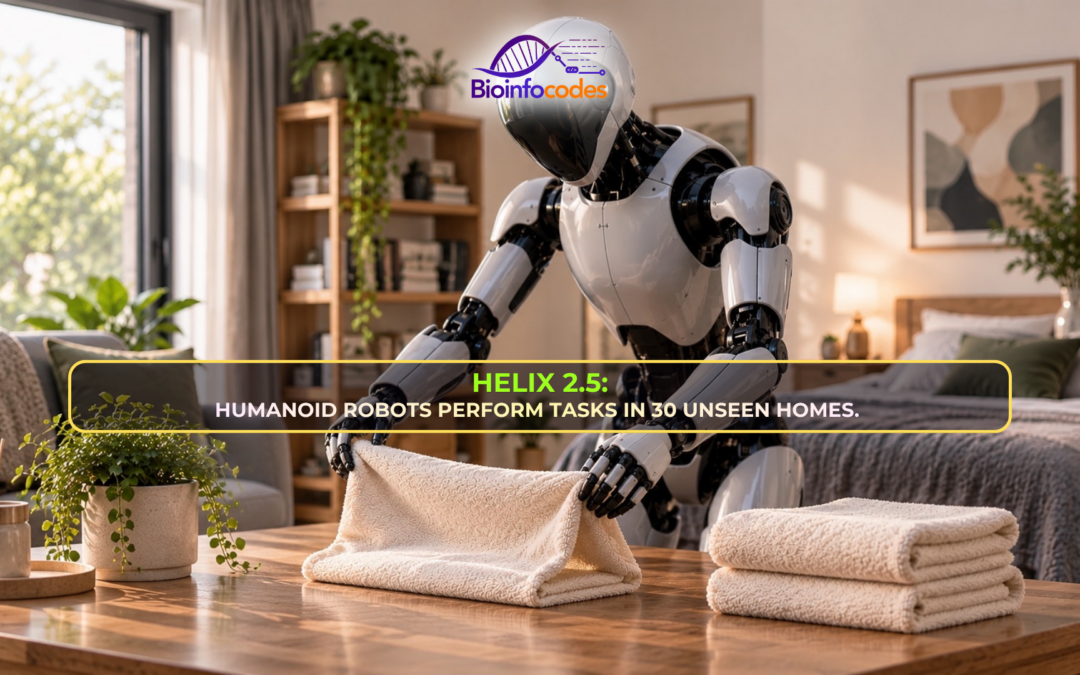
Humanoid robotics requires systems capable of coordinating perception, locomotion, and object manipulation in environments that differ in layout, furniture, and the objects encountered. Unlike approaches developed around fixed workspaces, domestic environments require robots to move through confined and cluttered spaces while positioning their bodies to see, reach, and manipulate objects. Figure AI’s Helix 2.5 addresses this challenge by investigating whether a humanoid robot can perform complex, whole-body tasks in unfamiliar homes without collecting environment-specific data or adapting its model after arrival.
The central problem addressed by the system is the limited transfer of learned robotic behaviors to environments that were not represented in the training data. Figure AI reports that its preceding Helix 02 system demonstrated long-duration autonomous task execution, but its behaviors were trained using data collected in the environments where the robots would operate. Helix 2.5 was developed to investigate whether a single pretrained foundation model could support multiple behaviors across previously unseen domestic environments. The system uses zero-shot generalization to assess whether learned behaviors can transfer to unfamiliar environments and objects without environment-specific data collection or adaptation. The task behaviors were specified using fine-tuning data collected elsewhere.
The researchers pretrained Helix 2.5 on Index, Figure AI’s large-scale dataset of human behavior, and developed three behaviors from the resulting foundation model: living-room tidying, towel folding, and bed making. These tasks combine locomotion, rigid and deformable object manipulation, bimanual coordination (coordinated use of both hands), active perception (gathering information through purposeful sensing and movement), and whole-body control. The team evaluated the resulting policies in 30 previously unseen homes in the San Francisco Bay Area, without collecting data in those homes or using the evaluation objects in task-specific training. To isolate the contribution of pretraining, the researchers also compared policies trained on identical task-specification data, holding the architecture, optimization, hyperparameters, downstream training data, and evaluation conditions constant while changing the model initialization. In a separate scaling experiment, four models were trained on nested subsets of Index spanning an eightfold increase in pretraining data, with model size and downstream training held fixed.
In blind evaluations, the policy initialized from the Index-pretrained model achieved a zero-shot success rate of 56%, compared with 9% for the policy trained from scratch. Success required completing the entire task rather than receiving partial credit for individual actions. The researchers also report that Helix 2.5 matched the success rate of a representative Helix 02 policy while using half as much task-specific adaptation data, despite generalizing across 30 unseen homes. Qualitative evaluations showed that the robot could recover from errors by repositioning its body, changing its stance, or moving around a bed to correct a fold. In the scaling experiment, robot-action prediction loss decreased predictably as Index pretraining data doubled. The team forecast the largest training run’s test loss to four decimal places using smaller runs, with a forecasting error equivalent to 0.54% of the variation across the full eightfold data range. Figure AI reports that Index pretraining accounts for most of Helix 2.5’s zero-shot capability. The evaluation covered three behaviors across 30 homes.
The results provide evidence that human-behavior pretraining can support the transfer of whole-body robotic behaviors to domestic environments without environment-specific fine-tuning. Figure AI explicitly notes that the work does not establish that general-purpose humanoid robotics has been solved. Instead, Helix 2.5 demonstrates a specific approach in which a broadly pretrained model is adapted to defined behaviors and then evaluated across unfamiliar environments, providing a basis for further investigation of generalization in humanoid robotics.
Author: Yağmur Aktepe
Editor: Hazel Birgül
Reference: Figure AI. (2026, September 17). Helix 2.5: Zero-shot 30-home generalization. https://www.figure.ai/news/helix-2-5-zero-shot-30-home-generalization
-Bioinfocodes Scientific News Service-
News articles prepared by our team members, reviewing and compiling scientific research
published in journals with and impact factor greater than 20 (click here for the list)