
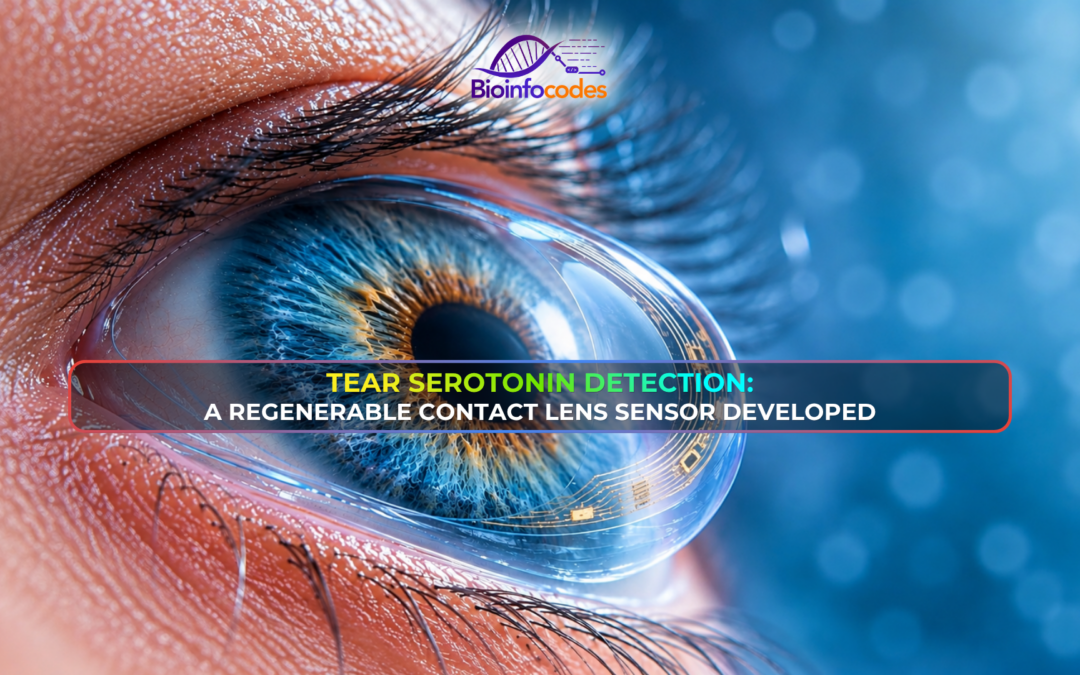
Stress-related endocrine responses are relevant to the assessment of human performance and mental health, yet conventional approaches often depend on subjective self-report questionnaires or invasive sampling procedures such as venipuncture. Tears provide a noninvasive source of neurochemical biomarkers, including serotonin, a neurotransmitter involved in stress-related physiological processes However, real-time and continuous measurement of serotonin in tear fluid remains a technological challenge . Addressing this limitation, researchers developed a lab-on-a–contact lens platform designed for in situ serotonin detection directly in tear fluid.
The study focused on the development of a reversible sensing system that could detect tear serotonin while maintaining its analytical performance over repeated measurements. The platform integrates a printable and stretchable ferrocene-based electrochemical sensor into a soft hydrogel contact lens. A central feature of the system is an electrochemically refreshable redox surface, which enables the sensor to restore its baseline state between measurements. In repeated-use experiments, the sensor underwent 100 washing cycles and 300 serotonin measurements, corresponding to 400 use cycles, with a relative standard deviation (RSD) of 5.3%. The researchers evaluated the analytical performance, mechanical stability, durability, and ocular biocompatibility of the platform, followed by testing in animal and human samples.
The sensor was fabricated directly on a soft hydrogel lens and calibrated using artificial tears. Its analytical performance was characterized by a limit of detection of 72 picomolar and a dynamic range extending from 0.1 to 500 nanomolar. The platform maintained its function for more than 28 days in a tear-like environment and remained operational after repeated mechanical deformation, including flipping, folding, stretching, and twisting. Periodic redox cycling was used to confirm sensor stability. Ocular safety and biocompatibility were evaluated using a porcine eye model, while the relationship between tear serotonin and stress-related endocrine responses was investigated in a chronic stress mouse model and subsequently in a first-in-human pilot study.
The experimental results showed that chronic stress was associated with decreased serotonin concentrations and increased cortisol concentrations in both serum and tears in mice. Positive correlations were also observed between serum and tear serotonin concentrations (r = 0.7455, P = 0.0174) and between serum and tear cortisol concentrations (r = 0.9152, P = 0.0005) The human pilot study, involving 10 participants in the Trier Social Stress Test (TSST), further supported an association between tear serotonin and stress, with collected tear samples analyzed offline using the lab-on-a–contact lens platform. Together, these findings demonstrate that the contact lens-based electrochemical platform can detect serotonin in tear fluid while retaining its functionality under prolonged exposure to tear-like conditions and repeated mechanical deformation.
The study presents a reversible contact lens-based approach for noninvasive monitoring of serotonin in tear fluid. In addition to the stress-related findings, the researchers reported a negative correlation between tear serotonin concentrations and Dry Eye Questionnaire-5 (DEQ-5) scores in 17 participants (r = −0.5751, P = 0.0172). By integrating an electrochemically refreshable sensor into a mechanically flexible hydrogel lens, the platform addresses the need for repeated serotonin measurements without relying on conventional invasive sampling. The reported performance in artificial tears, porcine eyes, a chronic stress mouse model, and a first-in-human pilot study supports the potential of the system for decentralized, noninvasive endocrine monitoring. It also provides a foundation for further development toward wireless, continuous monitoring of tear-based biomarkers, although additional optimization and validation are required.
Author: Ayşenur Güneş
Editor: Nehir Necem Ünlü
Reference: Kim, M., Lee, S. W., Zhang, C., Zeng, W., Liu, L., Garrett, A. D., Haghniaz, R., Meyer, D., Chen, J., Guo, J., Tomiyama, A. J., Kollbaum, P. S., & Zhu, Y. (2026). Serotonin measurement by lab-on-a–contact lens in porcine and human tears. Science Translational Medicine, 18(867). eadv9538. https://doi.org/10.1126/scitranslmed.adv9538