
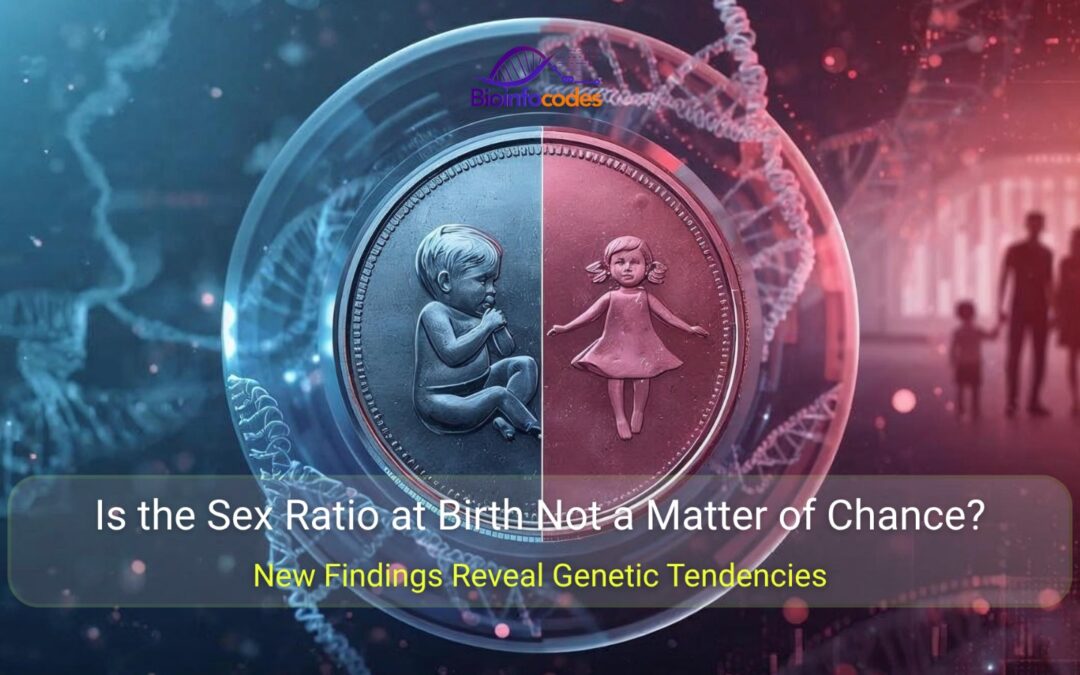
Sex determination has long been explained using the “heads or tails” analogy. However, new findings show that the issue is not that simple. Siwen Wang and her team at Harvard University and Brigham and Women’s Hospital examined 146,064 births (excluding twin and multiple pregnancies) from 58,007 women living in the U.S. between 1956 and 2015 and reached striking results. The findings indicate that the tendency of some mothers to have only female or only male children actually points to the existence of family-specific probabilities.
This new research, published in Science Advances, reopened the long-standing assumption that biological sex is determined with approximately equal probability at each birth, and showed that the results are better explained by a beta-binomial distribution rather than a simple binomial one. The team, which examined a total of 146,064 births from 58,007 women living in the U.S. between 1956 and 2015, obtained remarkable findings. The data did not conform to the expectation of a completely random distribution; in some families, all children being of the same sex occurred significantly more frequently than expected. This unexpected pattern led researchers to re-evaluate probability models.
According to the studies, it has been shown that sex at birth follows a beta-binomial distribution rather than a simple binomial one. This distribution, unlike the classic heads-or-tails equivalence, shows that some families use a “weighted heads-or-tails” — meaning that some individuals’ sex determination tendencies are systematically shifted.
To investigate the reasons behind this interesting situation, scientists also conducted analyses at the genetic level. In addition to the analysis of over 146,000 birth data, genetic data from more than 7,500 mothers were examined, and certain genetic variants were found to be associated with the tendency to have children of a specific sex.
It was determined that the NSUN6 gene variant was more frequently seen in mothers who had only daughters, while variation in the TSHZ1 gene was associated with those who had only sons. These findings suggest that genetic factors may play a role in differences in sex distribution.
Another striking finding of the study was the connection between the age at which the mother gave birth for the first time and this tendency [2.1]. According to the findings, women who had their first child after the age of 28 were found to have a higher probability of all their children being of the same sex.
The results suggest that hormonal or physiological processes may be influential along with maternal age; however, how exactly this connection works is not yet known. Such analyses revealed that the findings were not solely due to cultural preferences but that biological factors could also play a role. Researchers also conducted various sensitivity analyses to check the robustness of the results [3.1]. For example, in order to exclude the tendency of families to continue having children until they have both sexes—known as the “coupon-collector effect”—the last children were excluded from the analysis [4.1]. This measure reinforced that the findings could be explained not merely by cultural preferences but by biological mechanisms [5.1].
What do these results mean? Although it has not yet been clarified whether a baby’s sex can be planned or predicted, the study reveals that biological sex determination is more complex than previously thought. The Harvard team stated that these findings could lead to new research aimed at understanding whether sex determination tendencies are cultural or biological by testing them in other societies [6.1].
In conclusion, the question of whether the sex of an unborn child is purely a coincidence or shaped by certain biological factors is now being addressed in greater depth. It seems that not every coin toss may truly be fair.
Author: Büşra Yaşar
Editor: Pelinsu Albey
Visual Design: Zeynep Gülenç
Reference: Wang, S., et al. (2025). Is sex at birth a biological coin toss? Insights from a longitudinal and GWAS analysis. Science Advances, 10.1126/sciadv.adu740 https://www.science.org/doi/10.1126/sciadv.adu7402
-Bioinfocodes Scientific News Service-
News articles prepared by our team members review and compile scientific research published in journals with an impact factor greater than 20 (click here for the list).