
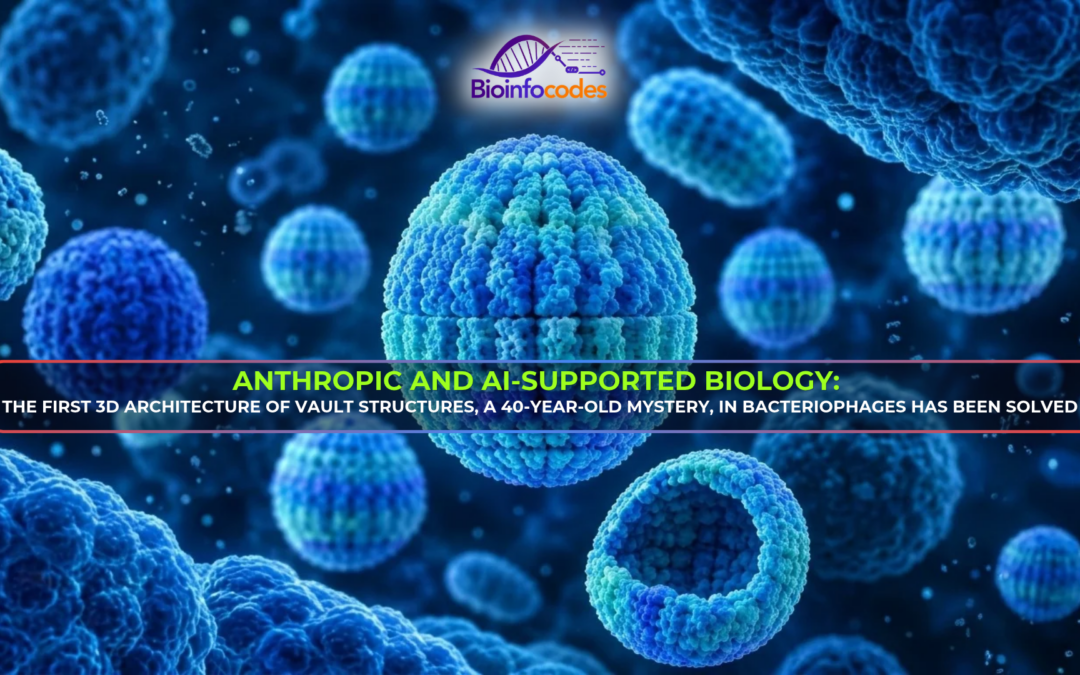
In biological evolution, which extends from unicellular organisms to human cells, the functions and origins of intracellular structures constitute the fundamental research areas of modern biotechnology. Whether “vault” structures, which are the largest known nucleoprotein particles in eukaryotic cells and whose function has not been fully elucidated since their discovery, exist in prokaryotes and bacteriophages has long been unknown. This situation necessitates the investigation of these large structures, whose evolutionary origin is uncertain, and the screening of prokaryotic homologues to reveal architectural diversity and engineering potential.
Anthropic researchers (Januka S. Athukoralage et al.) conducted a comprehensive metagenomic screening and structural analysis in order to systematically investigate whether prokaryotic and bacteriophage major vault protein (MVP) homologues form vault nanoparticles. The research team conducted a database screening covering approximately 15 billion protein sequences, identifying a total of 1,507 MVP/MVP-like protein groups across 29 bacterial and 4 archaeal phyla; among these, candidates expressed in Escherichia coli (E. coli) were isolated by size-exclusion chromatography [SEC; a chromatographic method that enables molecules to be separated according to their sizes], and their structures were confirmed by electron microscopy.
Within the scope of the methodological approach, large-scale screenings performed using profile hidden Markov models (HMMs) belonging to the shoulder region and AlphaFold2-based structure predictions were carried out. The selected candidate proteins were produced in E. coli and cell-free systems; particles separated by size-exclusion chromatography were analysed by negative staining and high-resolution cryogenic electron microscopy [cryo-EM; the examination of frozen biological samples at high resolution using an electron microscope]. In addition, in order to test the structural rules, engineered variants containing L05+2 and L05+4 variants with increased numbers of wall repeats and single-point mutations (R55E, I794D, etc.) were designed.
The main findings obtained reveal that prokaryotic and bacteriophage MVP homologues are capable of forming vault particles. The structure of the bacteriophage L05 homologue, which was resolved by cryo-EM at a resolution of 3.2 Å, presented a shell consisting of a total of 96 MVP chains, with 48 in each half, in contrast to the 39 chains in mammalian vaults; this structure provided an approximately 25% larger internal volume (~40,000 nm³) than human vaults. Densities to which small molecules similar to coenzyme A (CoA) were bound were detected in the L05 wall pockets, and it was demonstrated that the internal volume could be increased by 50% (~48,000 nm³) compared with the human vault by changing the wall curvature by 16 degrees through increasing the number of wall repeats (L05+2 variant). It was stated that a single charge-change mutation at the wall seam (R55E) or point mutations in the cap helix (I794D) disrupted closed-shell formation, leading to rosette-like structures, which also demonstrates the sensitivity of structural assembly.
By demonstrating the existence of prokaryotic and phage-derived vaults, this study has expanded knowledge about evolutionary origins and positioned these structures as a platform for size-tunable nanocapsule engineering. The molecular data and high-resolution structures obtained indicate that these structures can be considered a size-tunable scaffold for nanocapsule engineering and cargo-packaging applications.
Translated by: Ziya Burak Ekinci
Editor: Hazel Birgül
References:
https://www.anthropic.com/research/investigating-vault-particles-with-claude
https://www-cdn.anthropic.com/76e55fbe85697afbaae16b839498dc00797dec30.pdf